
Launching a new luggage collection is one of the most capital-intensive moves for any travel brand. Whether you are an established DTC eCommerce player expanding into hard-shell suitcases or a sourcing manager debuting a premium luggage line, your initial factory order dictates your profit margins for the entire year.
Yet, far too many brands watch their projected margins evaporate long before the first container leaves the port. Unexpected sample iterations, shipping air in half-empty containers, and sky-high after-sales return rates frequently turn promising product launches into financial sinkholes.
The Hard Truth of Luggage Sourcing:
80% of budget overruns are not caused by manufacturing errors on the assembly line—they stem from “Paper Decisions” made during the initial product specification and sourcing phase.
The Hidden Financial Drain of a Product Launch
When a luggage launch goes over budget, the blame is often placed on rising raw material prices or factory surcharges. In reality, budget erosion happens silently across three key operational stages:
- 80% Budget Waste Pre-Production: Vague tech packs lead to 3+ rounds of costly sample re-engineering, delaying launch dates by up to 12 weeks.
- 35% Freight Premium: Poorly planned outer box dimensions result in shipping dead space inside 40HQ ocean containers.
- 3x–5x Return Cost Penalties: Selecting low-grade component hardware (wheels, zippers, handles) to save $2 on FOB price leads to high Amazon RMA rates that obliterate front-end margins.
What You Will Learn in This Guide
As a premier OEM/ODM luggage manufacturer supplying leading global brands, we have seen both sides of the spectrum: brands that scale seamlessly with 40%+ gross margins, and brands that burn through their entire development budget before shipping a single unit.
This guide breaks down the 3 most fatal budget-killing mistakes in luggage development—spanning product specification, contract negotiation, and shipping logistics—along with the exact SOPs our manufacturing partners use to eliminate hidden costs before production begins.
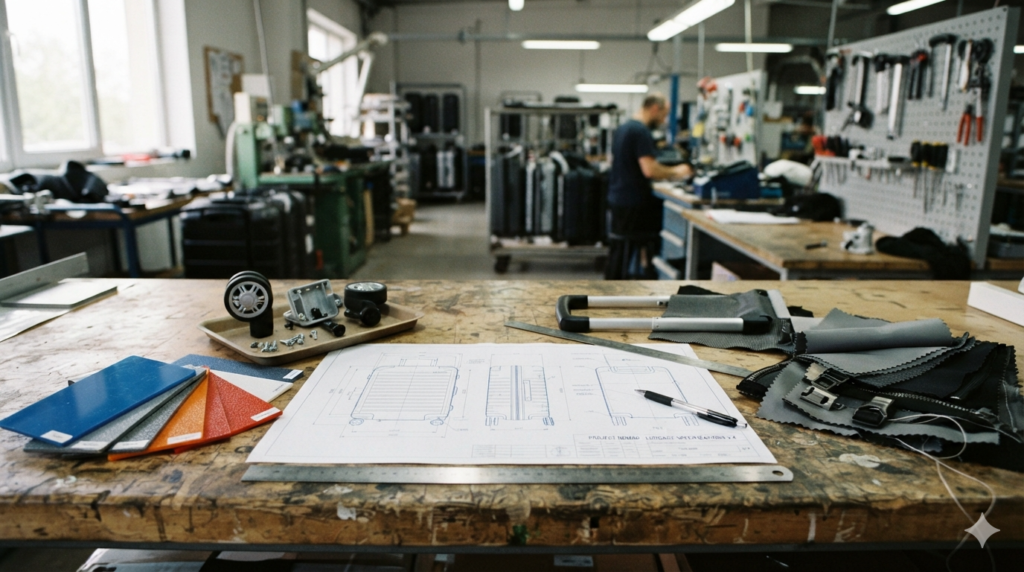
Mistake 1: Spec & Design Blindspots (The “Photo-Only” Trap)
The fastest way to burn through your development budget is to rush into factory quoting without concrete technical specifications. Too many brand owners approach OEM suppliers with nothing more than an Amazon product URL or a couple of high-res photos, asking: “How much to make this?”
When a factory quotes based purely on a photograph, they are forced to make dozens of invisible assumptions regarding material density, wall thickness, component grades, and internal construction. The result? A lowball quotation that spikes by 30% to 50% once actual physical sampling begins—or worse, a product that fails in the hands of end customers.
2.1 “Photo-Only” Inquiries vs. The Standardized B2B Tech Pack
Relying on photographs alone guarantees multiple rounds of sample re-engineering, costing $500–$1,500 per iteration and delaying your market entry by months. Professional sourcing managers never negotiate without a standardized B2B Tech Pack.
| Sourcing Approach | Photo-Only Inquiry | Standardized B2B Tech Pack |
| Quoting Accuracy | Unreliable (±30% price variance later) | Precise FOB pricing guaranteed in writing |
| Sample Iterations | Average 3–5 rounds of trial & error | 1–2 rounds max to finalize production sample |
| Product Consistency | High risk of factory substituting cheaper parts | Fully enforceable bill of materials (BOM) |
| Development Time | 8 to 16 weeks wasted in redesigns | 2 to 4 weeks from spec to approved sample |
The 8 Essential Parameters Every Luggage Tech Pack Must Include:
- Shell Material & Virgin Ratio: (e.g., 100% Bayer German Polycarbonate vs. 70/30 PC/ABS blend; shell wall thickness: 2.2mm ± 0.1mm).
- Telescopic Handle Spec: Tube wall thickness (1.0mm aluminum), locking positions (3-stage), and allowable play/shake clearance (<15mm).
- Wheel Assembly: Japanese Hinomoto or OEM double-ball-bearing quiet wheels with TPE rubber tread.
- Zipper Grade: Zipper teeth size (#8 vs #10), chain type (anti-theft double-layer vs standard), and brand (YKK / SBS).
- Inner Lining Fabric: Fabric weave and density (e.g., 210D vs 420D Polyester with PU coating) and fabric weight (GSM).
- TSA Lock Specification: Integrated flush-mount TSA 007/008 lock with custom brand engraving options.
- Reinforcement Zones: Internal corner reinforcement pads and rivets material (steel vs aluminum).
- Target Empty Weight & Capacity: Hard cap on empty weight (e.g., Carry-On 20″ ≤ 2.7kg / 38L volume).
2.2 The Interior BOM Trap & The Strict Empty Weight Budget
The Invisible Cost of the Inside
While most brands focus 90% of their attention on the exterior hard shell, the interior lining, dividers, mesh pockets, and compression straps account for 15% to 25% of the total Bill of Materials (BOM).
Opting for complex interior organizational panels with multiple zippered TPU wet-pockets without calculating fabric yield can silently add $3.50–$6.00 to your FOB price per unit.
Design Optimization Tip: Standardize internal lining patterns across your 20″, 24″, and 28″ models to maximize fabric cutting efficiency and reduce material wastage from 18% down to under 5%.
Enforcing a Hard “Empty Weight Budget”
Airlines across Europe, North America, and Asia enforce strict carry-on weight limits (typically 7kg–10kg total). If your 20-inch carry-on weighs 4.2kg empty due to over-engineered internal frames and heavy decorative hardware, your customer is left with less than 2.8kg for their actual belongings.
When developing a new collection, establish a non-negotiable Empty Weight Ceiling:
- 20″ Carry-On: Target 2.5kg – 2.8kg (Never exceed 3.1kg)
- 24″ Medium Check-In: Target 3.4kg – 3.8kg
- 28″ Large Check-In: Target 4.2kg – 4.6kg
2.3 Tooling & Custom Mold Ownership Traps
If you are developing a unique exterior shell pattern, custom tooling/molds represent a significant upfront investment ($8,000 to $18,000 per size). Failing to structure tooling contracts properly creates major financial leakage:
1. Mold Amortization Calculation
Ensure you understand how tooling costs affect unit economics. If a custom 3-size mold set costs $36,000, your per-unit cost structure changes drastically based on order volume:
Mold Cost Per Unit=Total Custom Mold Investment/Total Lifetime Order Volume (Units)
*Initial Batch (1,000 units): Adds $36.00 / unit if fully absorbed upfront.
*Amortized over 20,000 units: Adds only $1.80 / unit to long-term cost.
2. The Mold Ownership Clause
Always insist on an explicit Mold Ownership Agreement signed prior to paying the tooling deposit. Ensure the contract states that:
- The mold is 100% the property of your brand upon final payment.
- The factory is strictly prohibited from using your custom shell mold for public catalog sales or other clients (Exclusivity Clause).
- The factory must guarantee a mold maintenance lifespan of at least 300,000 shots/cycles.
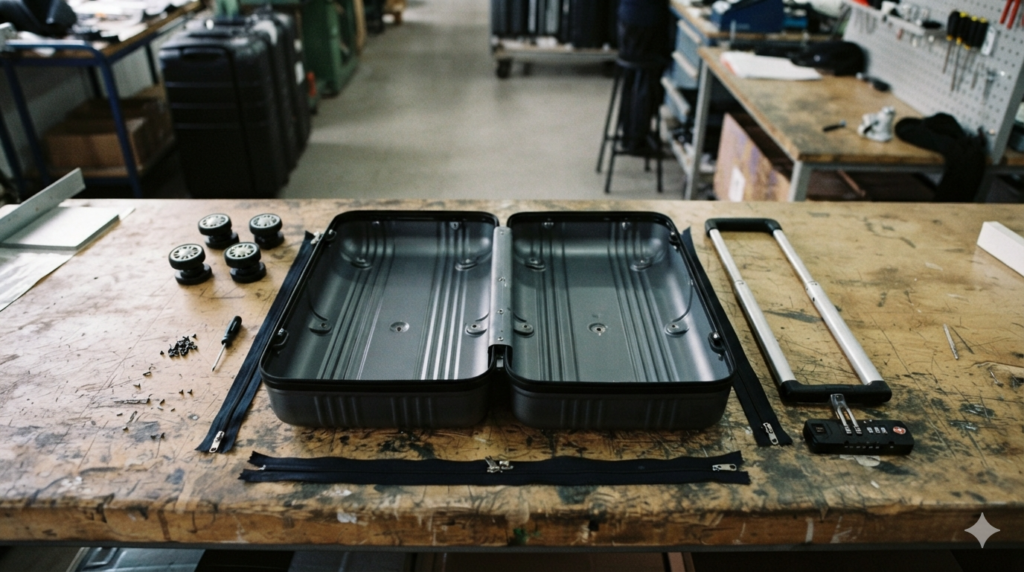
Mistake 2: Price-Centric Sourcing & Vague Contracts
Negotiating the absolute lowest FOB (Free On Board) price feels like a procurement victory on paper, but it is often the most expensive mistake a brand can make. When sourcing managers pressure a factory into matching an unrealistically low target price, the factory rarely absorbs the loss. Instead, they silently downgrade unseen components.
The initial savings of $2 to $4 per unit on the factory floor will eventually manifest as a 15% product return rate on Amazon, costing you upwards of $40 in reverse logistics and reputational damage per returned item.
3.1 The Lowest FOB Price Trap vs. Total Cost of Ownership (TCO)
Smart luggage brands do not optimize for FOB price; they optimize for Total Cost of Ownership (TCO), factoring in the “Cost Per Trip” and the RMA (Return Merchandise Authorization) rate.
Consider two hypothetical sourcing scenarios for a 20″ hard-shell carry-on:
| Cost Metric | Scenario A: The Lowest FOB Trap | Scenario B: The Value-Optimized Spec |
| Material Spec | 70% ABS / 30% PC Blend | 100% Bayer Makrolon® Polycarbonate |
| Hardware | Generic single-bearing wheels & unbranded zipper | Hinomoto quiet wheels & YKK anti-puncture zipper |
| FOB Price | $21.50 | $25.00 |
| RMA (Return) Rate | 12% (Cracked shells, broken wheels) | < 2% |
| Cost of 1 Return | ~$40 (Shipping + reverse logistics + refund) | ~$40 |
| Hidden RMA Cost (per 1,000 units) | $4,800 ($4.80 added per unit) | $800 ($0.80 added per unit) |
| True TCO (per unit) | $26.30 (plus brand damage) | $25.80 (plus 5-star reviews) |
The Takeaway: Scenario B requires a higher upfront investment of $3.50 per unit, but ultimately saves $0.50 in real terms while building customer loyalty. Never sacrifice core durability to hit arbitrary price targets.
3.2 Milestone Payment Terms: Protecting Your Capital
A standard 30% deposit / 70% before shipment payment term is meaningless if the “70% before shipment” is not contractually tied to passed quality control milestones. Without strict terms, brands often find themselves pressured to pay the balance just to release goods, even if minor defects are present.
The Golden Rule of Luggage Purchasing Contracts: Always align payment releases with independent quality verifications.
A robust B2B milestone payment structure looks like this:
- 30% Deposit: Paid only upon approval of the final Pre-Production (PP) Sample.
- DPI (During Production Inspection): Independent third-party inspection at 20% completion to verify raw material compliance (ensuring they aren’t using recycled PC instead of virgin material).
- 70% Final Balance: Paid ONLY after passing a formal PSI (Pre-Shipment Inspection) based on AQL 2.5/4.0 standards, accompanied by a stamped laboratory test report.
3.3 Writing Physical QC Standards into the Contract
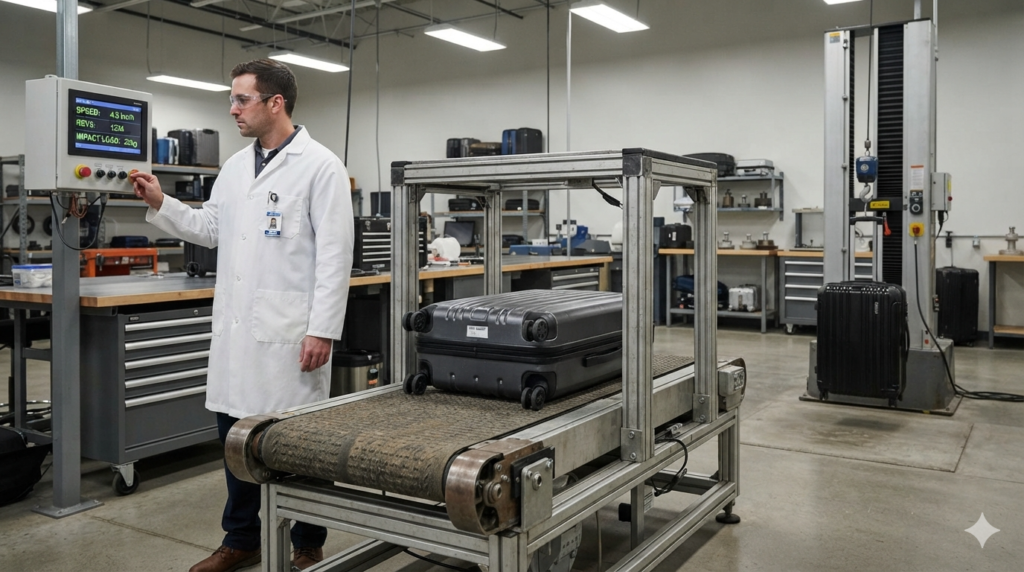
Luggage is a mechanical product subjected to extreme abuse. “Looks good” is not a quality standard. Your manufacturing contract must explicitly list the physical laboratory tests the factory must pass before releasing the shipment.
If these tests are not in the contract, you have zero legal recourse when handles snap off in transit.
The 6 Essential Contractual QC Tests for Luggage:
- Drop Test: Fully loaded (e.g., 15kg for 20″), dropped from 90cm height on all 8 corners, 6 faces, and 12 edges without shell fracture or wheel detachment.
- Telescopic Handle Jerk Test: 3,500 to 5,000 continuous upward jerks with a fully loaded case to test handle aluminum fatigue and rivet strength.
- Treadmill / Mileage Test: Continuous rolling of a loaded suitcase on a bumpy treadmill drum for 16km – 32km at 4km/h to verify wheel bearing endurance and rubber wear.
- Zipper Cycle Test: 5,000 open/close cycles under tension to ensure teeth do not split.
- Handle Bending Test: Static load test on top and side handles (e.g., 30kg suspended for 15 minutes) to test base plate structural integrity.
- Salt Spray Test: 48-hour salt spray exposure for all exterior metal hardware (zipper pulls, rivets) to ensure anti-corrosion compliance for ocean transit.
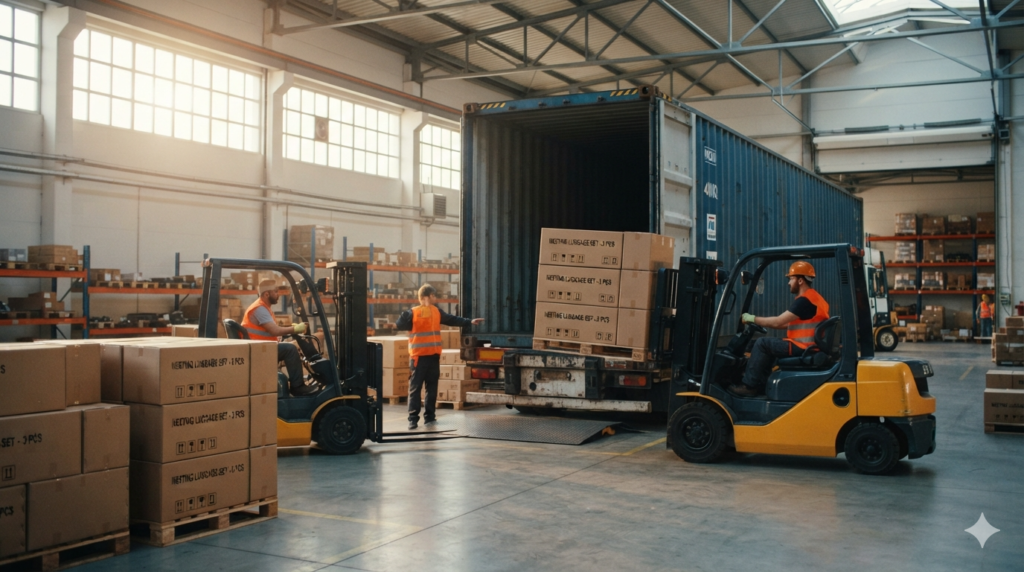
Mistake 3: Packaging, Loading & Compliance Oversight
You can design a flawless product and negotiate a competitive FOB price, but if your logistics strategy is an afterthought, international freight and customs compliance will quickly destroy your bottom line.
Shipping “air” across the ocean in half-empty containers, replacing crushed retail boxes caused by substandard packaging, or facing port impoundment due to chemical non-compliance are expensive logistics traps that are entirely preventable.
4.1 Nesting Sets vs. Single-Box Packing: Cutting Ocean Freight by 65%+
Ocean freight is calculated by volume ($/\text{CBM}$), not by actual weight, because hard-shell luggage is light relative to its physical size. If you ship 20″, 24″, and 28″ suitcases individually in separate corrugated cartons, you are effectively paying thousands of dollars to ship empty air inside the cases.
The Power of 3-Piece Nesting Sets
By designing your luggage collection as a compatible 3-Piece Nesting System—where the 20″ carry-on fits inside the 24″ medium case, which fits seamlessly inside the 28″ large case—you consolidate three individual units into a single outer carton.
| Packaging Strategy | Single-Box Packing (Individual Cartons) | 3-Piece Nesting Set (20″ + 24″ + 28″) |
| Units per 40HQ Container | ~550 individual pieces total | ~580 3-piece sets (1,740 total pieces) |
| Container Freight Cost | $4,500 (Assumed 40HQ spot rate) | $4,500 (Assumed 40HQ spot rate) |
| Freight Cost Per Unit | $8.18 / unit | $2.58 / unit |
| Freight Savings Realized | Baseline | 68.4% Cost Reduction Per Unit |
Logistics Optimization Note: Even if you sell your suitcases individually on e-commerce channels (such as Amazon FBA), it is far more cost-effective to ship bulk orders overseas as nested 3-piece sets, then unpack and re-carton them at a local 3PL warehouse prior to final delivery.
4.2 Transit Protection & Destination Compliance Traps
1. E-Commerce Transit Packaging (ISTA-1A / 3A Standards)
Retail store displays and e-commerce DTC parcel networks require drastically different packaging specs. A standard 3-ply carton meant for palletized retail distribution will fail instantly when handled by parcel carriers (FedEx, UPS, DHL).
- DTC E-Commerce Spec: Require 5-ply double-wall corrugated shipping boxes (minimum 200 lbs/in² burst strength).
- Protection Hardware: Mandate 8-point EPS foam or molded pulp corner protectors, a 0.05mm PE dust bag, and a protective film over shiny PC shell surfaces to prevent scratches during transit.
- Drop Test Standard: Demand that the factory conduct an ISTA-1A drop test (1 corner, 3 edges, 6 faces dropped from 76cm) on fully packaged sets before signing off on shipment release.
2. Chemical & Authorization Compliance
Failing to meet destination regulatory requirements can lead to delayed customs clearance, severe financial penalties, or mandatory destruction of your entire cargo batch.
- California Proposition 65 (USA): Test all PVC handles, soft touch coatings, and inner linings for Phthalates (DEHP, DBP, BBP) and Lead. Non-compliant items risk costly consumer class-action lawsuits in North America.
- EU REACH Compliance (Europe): Ensure all plastics and synthetic fabrics comply with European limits on Polycyclic Aromatic Hydrocarbons (PAHs), SVHCs (Substances of Very High Concern), and heavy metals.
- TSA / Travel Sentry Licensing: If you brand your TSA lock, verify that your manufacturer holds a valid licensing agreement with Travel Sentry or Safe Skies. Unlicensed “knockoff” TSA locks can be seized by customs officials for trademark infringement.
Section 5: Bonus Toolkit — Pre-Production Cost Control Checklist & Interactive Calculator
To ensure your luggage collection stays on budget before committing capital to production, your procurement team should conduct a systematic review. Below is the B2B Pre-Production Checklist used by experienced sourcing managers, followed by an interactive tool to estimate your production, freight, and risk-adjusted costs in real time.
5.1 Pre-Production Cost Control Checklist
Run this checklist prior to signing any purchase order (PO) or paying factory deposits:
| Category | Audit Item / Parameter | Status | Risk Mitigation Standard |
| Product Spec | Detailed Tech Pack finalized (Material, Wall Thickness, Hardware, Weight Budget) | [ ] | Mandatory 8-parameter spec Sheet attached to PO as an enforceable contract appendix. |
| Material Spec | Raw material compliance & virgin plastic ratio verified | [ ] | Demand material lab test certification (e.g., 100% Bayer Makrolon® PC, no recycled scrap). |
| Tooling & Molds | Mold ownership and exclusivity agreement signed | [ ] | Explicit contract clause guaranteeing 100% brand ownership upon final payment and non-compete usage. |
| Quality Control | 6 mandatory laboratory physical QC tests written into contract | [ ] | Drop, Jerk, Mileage, Zipper, Handle Bending, and Salt Spray tests bound to 70% final payment. |
| Payment Terms | Milestone-based 30/70 payment structure linked to PSI inspection | [ ] | Balance released ONLY after passing AQL 2.5/4.0 Pre-Shipment Inspection with stamped lab report. |
| Logistics | 3-Piece Nesting Set packaging engineered for 40HQ loading | [ ] | Verify 20″+24″+28″ nested dimensions to maximize container CBM and cut per-unit sea freight. |
| Packaging Spec | E-commerce ISTA-1A drop test standard approved | [ ] | 5-ply corrugated carton, EPS corner protectors, and protective film specified for DTC delivery. |
| Compliance | Destination port chemical & licensing compliance confirmed | [ ] | CA Prop 65 / EU REACH test certificates on file; valid Travel Sentry TSA lock license verified. |
5.2 Real-World Cost Model: Unoptimized vs. Value-Engineered Launch
To visualize the financial impact of pre-production decisions, let us compare two production strategies for a 1,000-set collection (3,000 individual suitcases total) shipped in a 40HQ ocean container to the United States.
| Sourcing & Logistics Metric | Scenario A: Unoptimized Launch | Scenario B: Value-Engineered Launch | Financial Impact |
| Material & Specs | 70/30 ABS/PC Blend, generic wheels | 100% Bayer Virgin PC, Hinomoto wheels | +$3.50 FOB per unit |
| Packaging Strategy | Single-Box Packing (Individual Cartons) | 3-Piece Nesting Set (20″+24″+28″) | Saved 2 extra outer cartons |
| Containers Required | 5.5 x 40HQ Containers ($24,750 freight) | 1.7 x 40HQ Containers ($7,650 freight) | -$17,100 Ocean Freight |
| Sea Freight Cost / Unit | $8.25 / unit | $2.55 / unit | -$5.70 / unit savings |
| Sample Iteration Cost | 4 rounds ($4,000 + 8 weeks delay) | 1 round ($1,000 + 2 weeks) | -$3,000 & 6 weeks faster |
| Expected Amazon RMA Rate | 10% ($40 average return loss/unit) | 1.5% ($40 average return loss/unit) | -$10,200 in return losses |
| True Total Landed Cost / Unit | $38.75 / unit | $31.75 / unit | Save $7.00 per unit (18% Total Margin Lift) |
The TCO Formula for Sourcing Managers
When evaluating supplier quotations, always calculate your True Landed TCO (Total Cost of Ownership) using this simple formula:
True Landed TCO=FOB Unit Price + Sea Freight Per Unit+(Target RMA % x Average Return Penalty)+(Tooling Fees/Order Volume)
By spending an extra $3.50 on better FOB specs while optimizing container loading via 3-piece nesting, Scenario B saves $7.00 per unit overall—turning a low-margin product launch into a highly profitable collection.
Section 6: Conclusion & Actionable CTA
Conclusion: Protecting Your Margin Before Production Begins
Developing a profitable luggage collection is not about luck, nor is it about beating down a factory’s margin until they cut corners. High-margin luggage brands succeed because they engineer cost efficiency into the product on paper, before a single raw material sheet is extruded.
By steering clear of the three fatal budget traps, your brand can secure long-term profitability and customer trust:
Eliminate Spec Blindspots: Ditch “photo-only” inquiries. Standardize your specifications with a comprehensive B2B Tech Pack and enforce a non-negotiable empty weight budget.
Focus on TCO, Not Just FOB: Avoid the low-FOB trap. Invest in durable component hardware to protect your Amazon RMA rate, and bind your 70% final payment to strict, contractually enforced laboratory physical QC tests.
Master Container Efficiency & Compliance: Never pay ocean freight to ship empty air. Design your collection as a 3-piece nesting system to cut freight costs by over 60%, and ensure full compliance with destination transit and chemical standards before shipping.
When you control your specifications, contract terms, and loading logistics upfront, you transform your supply chain from a constant financial risk into your biggest competitive advantage.
eady to Optimize Your Next Luggage Collection?
If you are currently developing a new hard-shell or soft-side luggage line, don’t leave your manufacturing margins to chance.
Partner with an experienced OEM/ODM luggage manufacturer who understands how to balance premium aesthetics with cost-effective industrial engineering.
Get a Free Pre-Production Engineering Review:
- Tech Pack & BOM Audit: Send us your existing design files or Amazon reference links. Our engineering team will review your bill of materials and identify potential cost leaks or durability risks.
- Container Loading Optimization: We will calculate your exact 40HQ container utilization and provide a customized 3-piece nesting layout to minimize your ocean freight per unit.
📩 Contact Our B2B Engineering Team Today:
Submit your Tech Pack or product inquiry to Contact Us to receive an optimized manufacturing proposal within 24 hours.