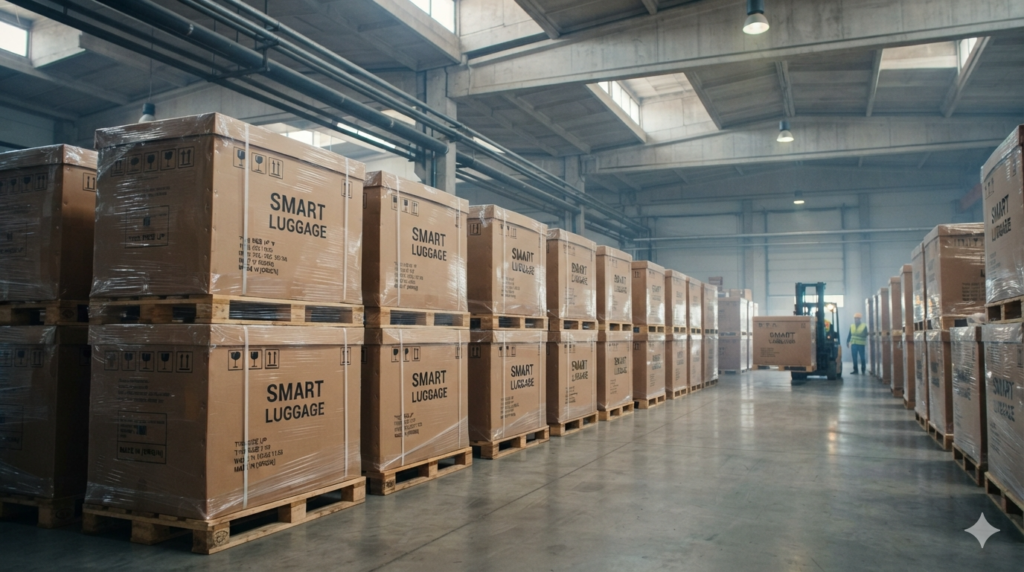
Introduction: The Paradigm Shift from Carrying Gear to Mobile Terminal
The global premium travel market is experiencing a profound structural transformation. Modern frequent flyers—particularly C-suite executives and tech-savvy business travelers across Europe and North America—no longer view luggage as a passive container to drag through terminal corridors. Instead, they demand seamless mobility, digital continuity, and uncompromised security. This evolution has triggered a paradigm shift, elevating the humble suitcase into an active, intelligent mobile terminal at the intersection of advanced material science, IoT (Internet of Things) connectivity, and micro-mobility engineering. For global luggage brands and B2B distributors, integrating smart technologies is no longer an optional gimmick; it is the definitive operational strategy to command premium price points, break free from low-margin manufacturing traps, and secure sustainable market differentiation.
[The Evolution of Luggage]
Traditional Trunks (Pre-1970s) ➔ The Wheeled Revolution (1970s-2000s) ➔ Smart Mobile Terminals (Present & Beyond)
“Smart mobility is redefining the luxury travel segment. Brands that treat luggage as an active ecosystem rather than static storage are capturing up to a 45% premium in retail margins across Western markets.”

Section 1: The Smart Hardware & Core Technology Matrix
1. Drive & Mobility Innovation (Ride-On & Following)
- Ride-On Propulsion: A standard ride-on suitcase must be tough. Instead of using cheap plastic frames that break easily under weight, we engineer an integrated, reinforced aluminium alloy internal skeleton. This ensures the suitcase can easily carry an adult up to 110 kg ($242\text{ lbs}$) without bending. The suitcase is powered by a reliable electric hub motor built into the front wheel, controlled by a simple handlebar throttle. The speed is safely limited to $10\text{–}13\text{ km/h}$ to comply with airport safety standards while keeping the acceleration smooth and easy to handle.
- Smart Following: For premium smart bags, we integrate Ultra-Wideband (UWB) tracking chips and simple ultrasonic sensors. The suitcase pairs with a lightweight wristband worn by the traveler. It calculates the user’s location instantly and moves automatically behind them at a normal walking pace, while the sensors prevent the bag from bumping into walls or other travelers in crowded terminals.
2. High-Reliability Security (Fingerprint & Tracking)
- Biometric Fingerprint Lock: To replace old-fashioned mechanical 3-digit combination locks, we embed a fast fingerprint scanner directly into the secure lock frame. It unlocks in less than $0.5\text{ seconds}$ with a gentle touch. It runs on a low-power internal battery that lasts for months, and always includes a mechanical backup key slot so the user never gets locked out if the battery dies.
- Global Location Tracking: To solve the biggest headache in travel—lost luggage—the bag features a built-in GPS and global eSIM tracking module. Buyers don’t need a physical SIM card; the luggage connects automatically to local mobile networks when arriving in Europe or America. If the bag moves more than $10\text{ meters}$ away from the owner, the system instantly sends an alert to their smartphone.
3. Smart Power & Weight Management
- The Travel Power Hub: The luggage serves as a reliable charging station with built-in USB-A and USB-C ports. It supports fast charging, delivering enough output power (up to $65\text{W}$) to charge smartphones, tablets, and even business laptops simultaneously safely without overheating.
- Built-in Digital Scale: To protect travelers from expensive airline overweight baggage fees, a weight sensor is built directly into the telescopic handle anchors. When the user lifts the bag by the handle, the exact weight shows up instantly on a small digital screen on the handle and syncs via Bluetooth to their phone app with an accuracy of $\pm0.1\text{ kg}$.
Section 2: Navigating Global Aviation Regulations & Compliance Red Lines
For international luggage brands, airline compliance is a strict pass-or-fail rule. To prevent customs rejections or airport boarding issues in Europe and North America, two manufacturing red lines must be strictly followed.
1. The 100Wh Removable Battery Rule
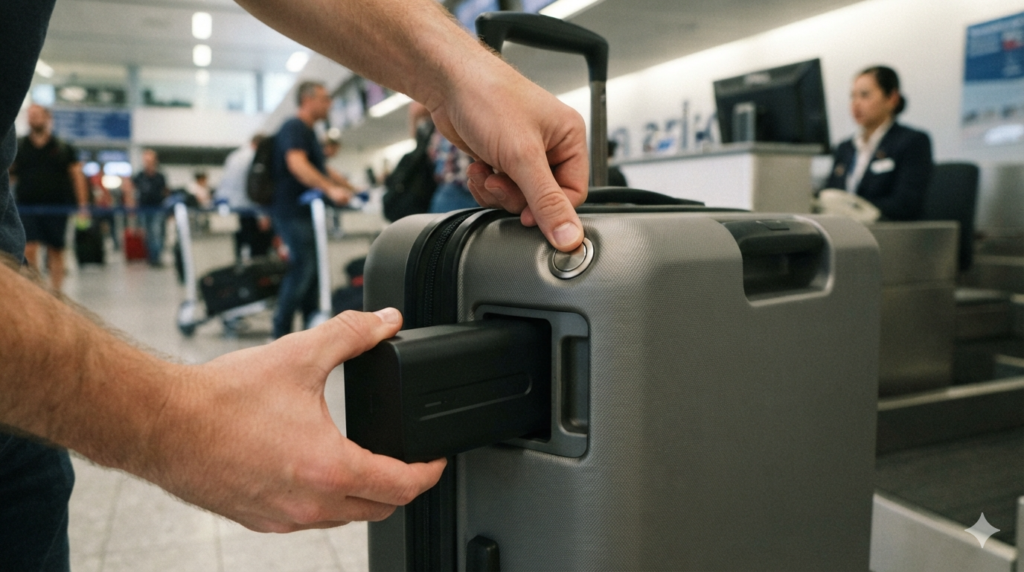
- 100% Removable Design: Airlines (IATA, FAA, and TSA) strictly ban suitcases with non-removable lithium batteries from checked baggage. Our suitcases feature a one-click mechanical quick-release battery dock. Travelers can pop out the battery module in 2 seconds at the check-in counter without opening the bag.
- Under 100Wh Capacity: The universal limit for passenger aircraft batteries is $100\text{Wh}$. Our factory configs standard smart packs at an optimized $73.26\text{Wh}$, which easily clears security while providing ample power for motorized riding and fast phone charging.
2. Dual-Access Locks & Export Certifications
- TSA-Approved Master Locks: Alongside fingerprint or electronic systems, our suitcases always integrate a standard TSA mechanical key cylinder. This allows border customs to perform inspections using their universal master keys without damaging the lock frame.
- Native Western Certifications: Since the luggage uses Bluetooth or UWB wireless connections, the electronics must pass emission standards. All our embedded components hold ready FCC certification for the US market and CE compliance for the European Union market.
📊 The B2B Smart Luggage Regulatory Compliance Matrix
| Smart Luggage Feature | Checked Baggage | Carry-on Cabin | Compliance & Manufacturing Standard |
| Non-Removable Battery | ❌ Strictly Banned | ❌ Banned | Banned globally due to cargo hold fire hazards. |
| Removable Battery ($\le 100\text{Wh}$) | (Battery in cabin) | The Golden Standard. Fully approved for mass manufacturing. | |
| TSA-Approved Key Override | Mandatory for US/EU. Prevents customs from breaking the case. |
Section 3: Hardware Integration & Supply Chain Challenges in Modern Manufacturing
Integrating electronic modules into traditional luggage shapes must be done practical and durable for mass manufacturing. The luggage frame must protect the electronics from rough baggage handling and light rain without complicating the production line.
1. Simple Shock Protection & Water Resistance
- Plastic Housing Protection: To protect the small PCB motherboard and wires from being crushed by heavy clothes inside or slammed during airport transit, the electronics are mounted inside a tight, hard plastic injection-molded box. This box is securely screwed between the aluminum telescopic handle tubes and hidden behind the internal lining fabric with a layer of protective foam padding.
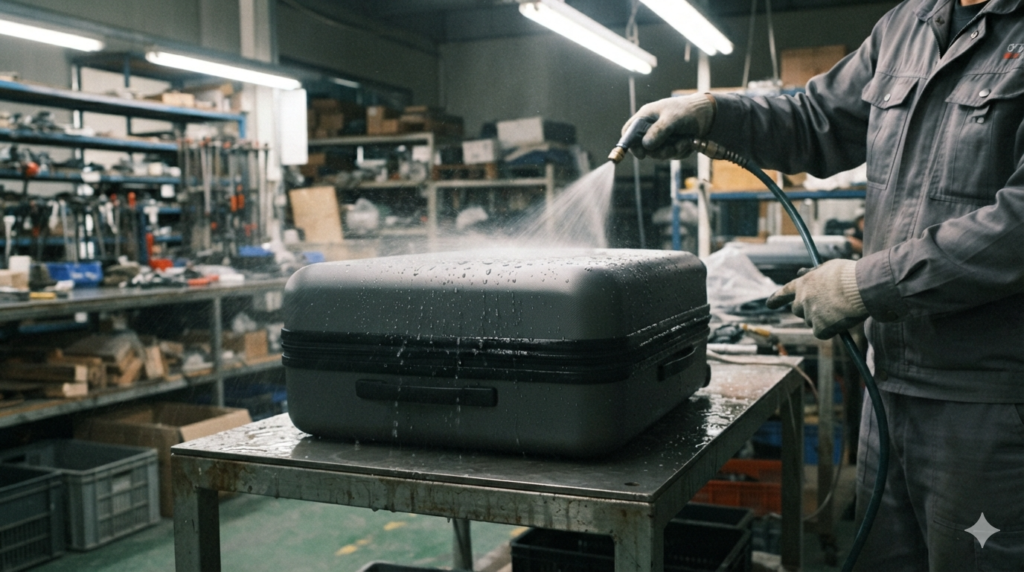
- Daily Rain-Proof Seals: Instead of expensive diving seals, we use practical weatherproofing for real-world use. The main zipper line is upgraded to a thick PU-coated water-resistant zipper (matte taped zipper). The telescopic handle slots feature built-in rubber gasket rings, and the external USB charging port is fitted with a tight-fitting silicone dust plug. This easily achieves an overall IPX4 spray rating, protecting internal electronics from accidental spills, wet airport runways, or light rain.
2. Durable Shell Materials & Eco-Friendly Linings
- 100% Virgin Polycarbonate (PC): For the main hardshell, our factory utilizes 100% pure, virgin PC material, avoiding weak recycled plastic blends. Pure PC is naturally flexible and tough; when compressed under 40 kg of heavy cargo weight in a truck, the shell will flex and bend without breaking, popping right back into its original shape once the pressure is released.
- RPET Linings for Western Compliance: To help European and American brands pass local green customs policies and sustainability standards, our fabric supplier offers certified RPET (Recycled Polyester) interior linings. This fabric is woven from recycled post-consumer bottles, providing a clean, odorless interior that satisfies Western environmental import guidelines.
Section 4: Ecosystem Connectivity: Companion Apps & Software Integration
A smart suitcase needs a reliable software connection to function properly. For B2B buyers, our factory simplifies the software process by providing a stable, pre-developed mobile application that pairs with the luggage electronics over a standard low-power Bluetooth (BLE) connection.
1. Ready-to-Use Factory App & SDK Customization
We understand that different overseas brands have different software budgets. Therefore, our factory provides two practical integration options:
- The Turnkey Factory App (White-Label App): We provide a fully developed, already-tested stable companion application. Buyers can simply upload their own brand logo and color theme, allowing them to launch a complete smart luggage product without spending money on software engineering.
- Open Bluetooth Protocols for Brand Apps: For larger Western brands that already have their own retail apps, our engineering team provides a complete, well-documented Bluetooth communications protocol. Your software team can easily paste our luggage control codes directly into your existing app.
2. Practical, High-Frequency User Functions
The software completely avoids useless, complicated features and focuses on three simple, everyday actions that travelers actually use:
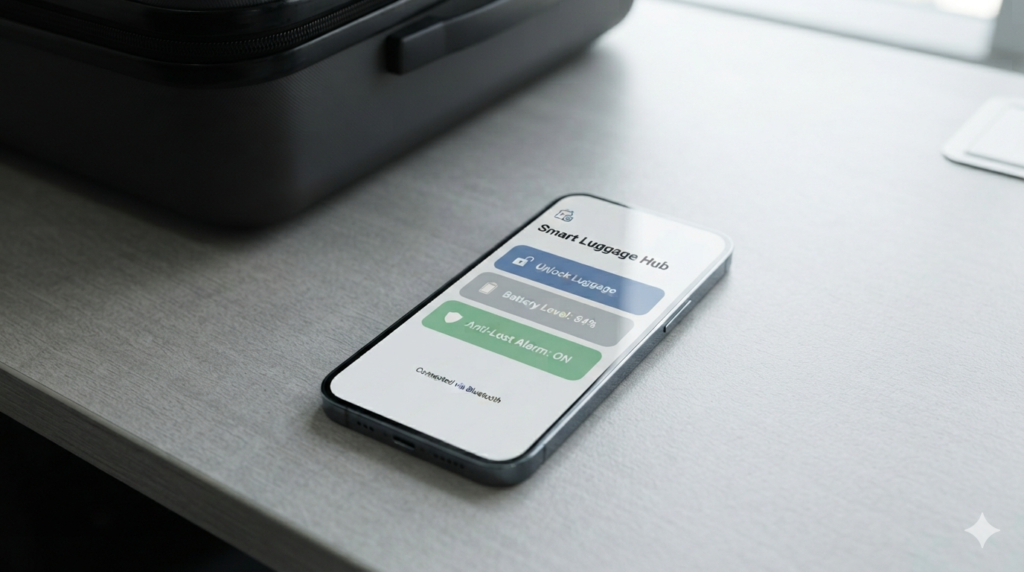
- One-Click Bluetooth Unlocking: Users do not need to scroll through mechanical dials in the dark. By opening the app, a simple tap on the screen instantly triggers the internal electronic latch to lock or unlock the suitcase.
- Anti-Lost Distance Alerts: The system monitors the Bluetooth signal strength between the phone and the bag. If a traveler accidentally leaves their bag behind at a cafe and walks more than $10\text{ meters}$ ($33\text{ feet}$) away, the app instantly pops up an alert window and vibrates to warn the user.
- Battery Power Checker: To prevent travelers from carrying a dead power bank, the app displays the exact remaining battery capacity percentage ($0\text{-}100\%$) directly on the home screen, letting users know when it is time to plug the bag into a wall charger.
Section 5: B2B Commercialization Guide: Strategic Procurement & Quality Control
For Western brand managers and procurement directors, adding a smart tech line requires balancing market positioning with rigorous hardware reliability. Choosing the right product tier and verifying factory quality control (QC) are the keys to a successful product launch.
1. Market Segmentation: Matching the Right Product to Your Audience
Our factory lines support two distinct market categories based on your brand demographics:
- The Executive Carry-On Line: Targeted at C-suite business commuters in the US and Europe. These are standard $20\text{-inch}$ dimensions featuring premium aluminum frames, fast biometric fingerprint locks, and external USB-C laptop power ports. The focus here is sleek minimalism and time-saving convenience.
- The Tech-Gadget Ride-On Line: Targeted at Gen-Z travelers, family vacationers, and tech enthusiasts. These suitcases integrate the front wheel motor and fold-out foot pedals, turning the luggage into a functional airport scooter. This line commands high retail margins and generates strong social media visibility for your brand.
2. Strict Factory QC Testing Standards
Smart luggage contains sensitive electronics, which means traditional bag testing is not enough. Our facility runs every production batch through a rigorous multi-point mechanical and electronic stress test sequence before pallet loading and shipping:
- Telescopic Handle Fatigue Test: The fully assembled smart handle is mechanically pulled up and pushed down $5,000\text{ times}$ under a $15\text{ kg}$ weight load to ensure the internal wiring inside the tubes never pinches or snaps.
- Loaded Wheel Mileage Test: The suitcase is packed with a $20\text{ kg}$ deadweight and placed on a continuous rolling test track at a speed of $4\text{ km/h}$, running for a total of $12\text{ kilometers}$ to prove wheel bearing and motor durability.
- Multi-Angle Drop Test: The finished luggage is dropped from a height of $1.2\text{ meters}$ onto a solid steel floor at twelve different angles. The hardshell must remain free of cracks, and the internal PCB electronic box must boot up normally post-impact.
- Electronic Circuit Temperature Shock Test: The internal control motherboards are placed in a specialized chamber, testing operational stability through severe temperature swings ranging from $-10^\circ\text{C}$ to $50^\circ\text{C}$ to simulate aircraft cargo hold environments.