
The Survivor Bias of Luggage Materials
In the global luggage market, there is a recurring “survivor bias.” When sourcing managers look at a new luggage collection, they often focus on the finish, the color palette, and the unit price. They see the samples sitting neatly on a showroom floor and assume performance will be the same after ten international flights and four conveyor belt transitions.
But for the modern B2B buyer—whether you are an Amazon seller, a private-label brand, or a regional distributor—the true cost of luggage isn’t found on the invoice. It is found in the hidden expenses of customer complaints, return logistics, and the erosion of brand reputation due to cracked shells and failed hardware.
Material science is not merely a technical specification; it is your primary risk management tool. This guide is designed to strip away the marketing jargon and focus on the cold, hard engineering reality: why high-grade Polycarbonate (PC) is the only logical choice for brands that prioritize performance over short-term savings.
Section I: The Molecular “Elastic Memory” — Why PC is Truly Unbreakable
In the world of polymer science, not all “plastics” are created equal. When your luggage undergoes the brutal impact of a baggage handler’s toss or the crushing pressure of a full cargo hold, its shell faces a critical test: Does it shatter, or does it recover?
The difference between failure and endurance lies in the molecular structure.
The Engineering Reality:
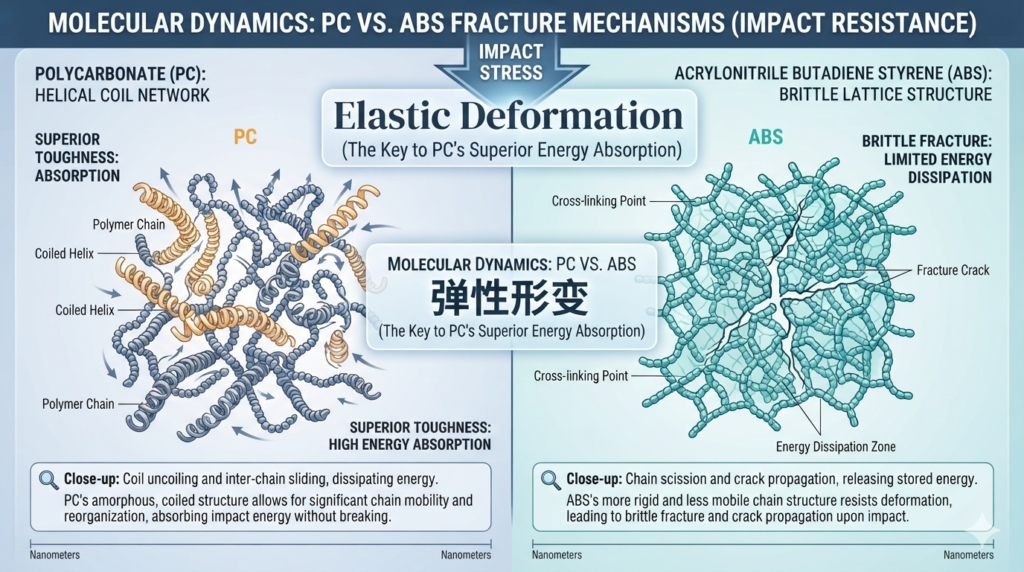
- ABS (Acrylonitrile Butadiene Styrene): A rigid material that gains its strength from a dense, static lattice structure. While it feels firm to the touch, it is inherently brittle. When subjected to stress beyond its limit, the internal bonds snap, resulting in permanent cracks or “stress whitening.”
- Polycarbonate (PC): PC is an engineering thermoplastic characterized by an amorphous, highly flexible molecular chain. Think of it as a microscopic “spring system.” When impacted, these chains absorb the energy, allowing the shell to undergo elastic deformation—a temporary dent that literally snaps back into its original shape.
Why This Matters to Your Business: This isn’t just a lab result; it is the difference between a satisfied customer and a negative review. A PC shell’s ability to dissipate kinetic energy ensures that your brand isn’t held responsible for the inevitable “battle scars” of travel. By choosing PC, you are not just selecting a material; you are selecting structural resilience that adapts to the rigors of global logistics.
Section II: The Hidden Manufacturing Barrier — From Material to Precision Molding
Many B2B buyers operate under a dangerous misconception: “If I choose PC, I will get a durable suitcase.”
While material selection is the foundation, it is not the entire building. The market is saturated with “PC luggage” that cracks within a few trips. Why? Because high-grade material is useless if the manufacturing process is compromised. The true competitive advantage lies in precision engineering.
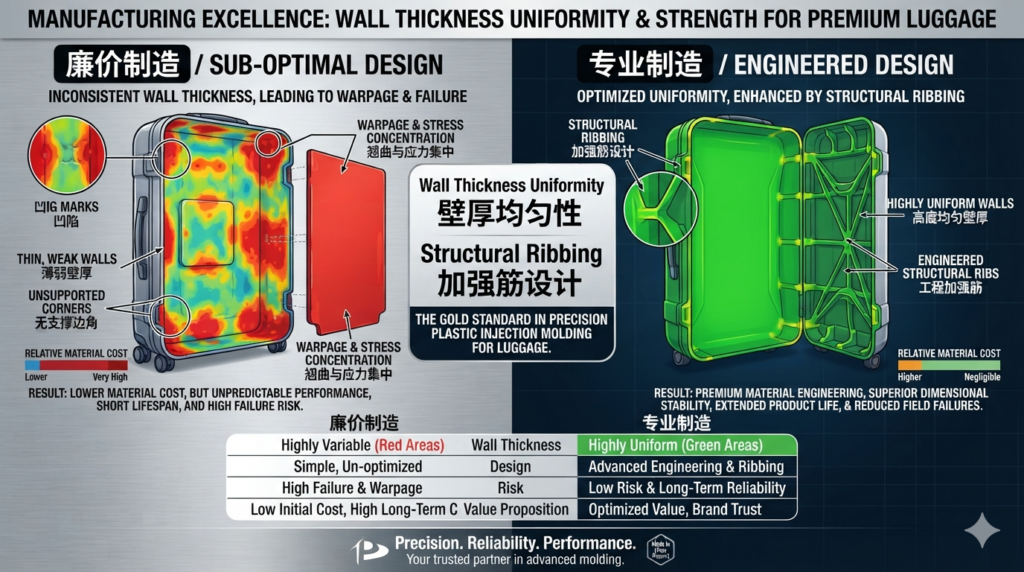
The Precision Molding Challenge: Polycarbonate is a high-viscosity material that demands strict thermal control during injection molding. Cheap factories often cut corners here. If the mold temperature fluctuates, or if the cooling time is shortened to increase production speed, the internal stress of the shell increases significantly. This creates invisible “weak points” where the material is thinner or more brittle, leading to catastrophic failure during airport handling.
Our Approach: Structural Integrity by Design:
- Wall Thickness Uniformity: We utilize advanced mold flow analysis to ensure that every corner, curve, and wheel housing maintains consistent wall thickness. A suitcase is only as strong as its thinnest point; we ensure there are no weak spots.
- Structural Optimization (Ribbing): We don’t just produce a flat shell. Our molds incorporate internal structural reinforcement (ribs) in high-stress areas. This mimics an exoskeleton, providing extra rigidity where it’s needed most without adding unnecessary weight.
Why This Matters: When your customers complain about a cracked wheel base or a collapsed handle mount, it’s rarely because the PC material was bad. It’s because the manufacturing process failed to distribute the physical load. By partnering with a manufacturer that treats injection molding as a science rather than a commodity, you eliminate these manufacturing-induced defects before they ever leave the warehouse.
Section III: Total Cost of Ownership (TCO) — The Economic Case for Premium Materials
In the luggage industry, the most expensive suitcase is often the one that costs the least to buy.
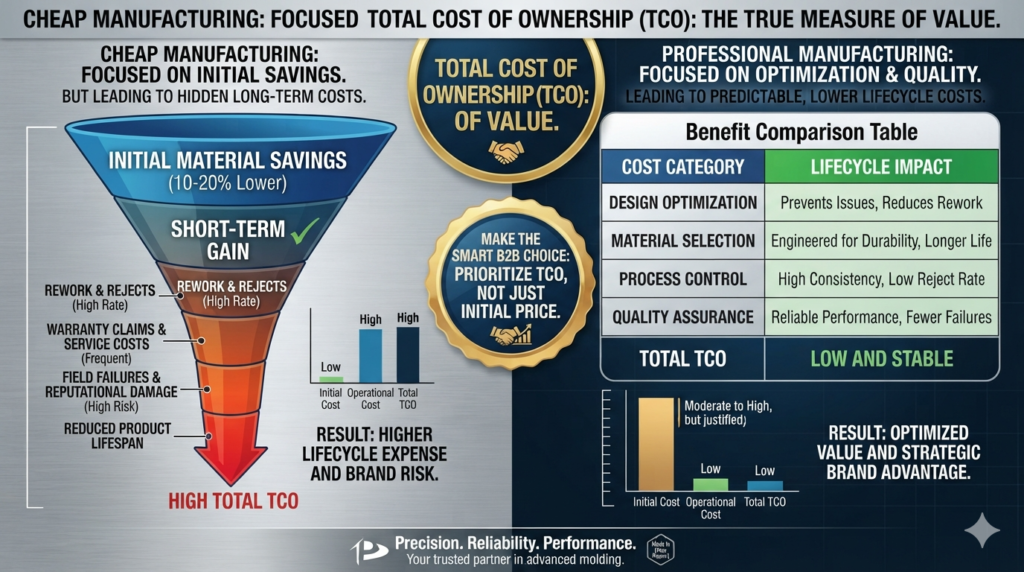
Many procurement managers fall into the “Unit Price Trap,” prioritizing the lowest factory-gate cost at the expense of long-term profitability. For B2B brands, Amazon sellers, and private-label owners, the true metric of success isn’t the cost of goods sold (COGS); it is the Total Cost of Ownership (TCO).
The Hidden Math of Cheap Luggage: If you choose a low-cost, inferior material like standard ABS, you may save $3–$5 per unit. However, consider the downstream costs:
- Return Logistics: Shipping a damaged, bulky suitcase back to your warehouse often costs more than the wholesale price of the unit itself.
- The “Rating Tax”: In the e-commerce era, one cracked corner leads to a 1-star review. These reviews permanently lower your conversion rate, effectively forcing you to spend more on advertising to attract new customers to replace the ones you lost.
- Customer Support Overhead: Managing complaints, processing refunds, and issuing replacements drains your team’s time—the most expensive resource in your company.
Why PC is an Investment, Not an Expense: Choosing high-grade Polycarbonate shifts your business model from “Transactional” to “Retentive.”
- High Resilience = Low Returns: Because PC resists impact rather than cracking under it, your return rate drops significantly.
- Brand Authority: Premium materials translate to a “premium feel.” When customers receive a product that feels solid and durable, they are more likely to leave positive reviews and recommend the product, effectively lowering your Customer Acquisition Cost (CAC).
The Bottom Line: An ABS suitcase is a liability that starts depreciating the moment it leaves your warehouse. A high-quality PC suitcase is a business asset—one that protects your margins, preserves your brand reputation, and builds long-term customer loyalty.
Section IV: The Professional Procurement Checklist — 5 Ways to Verify Shell Quality
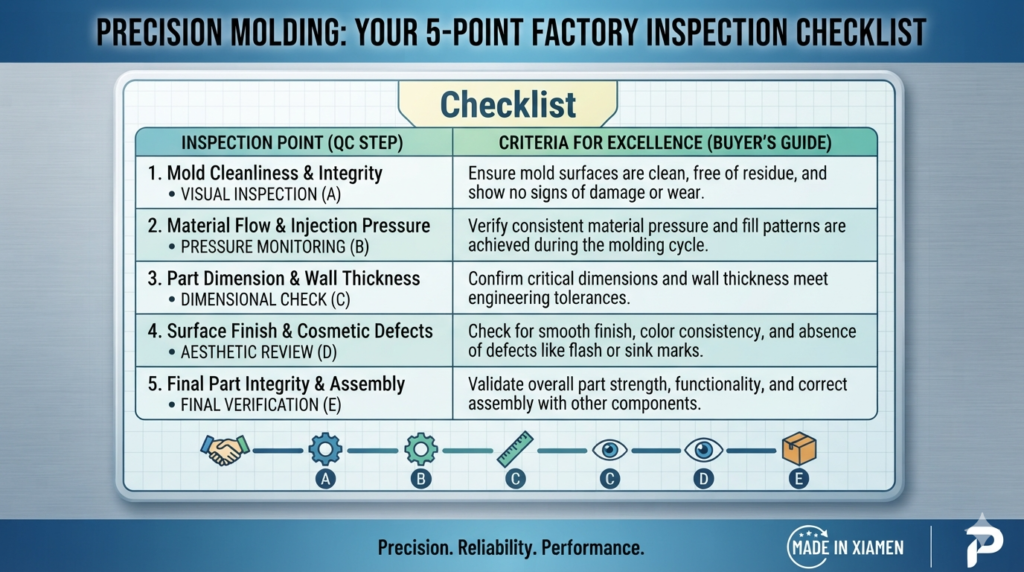
As a B2B buyer, you shouldn’t have to rely solely on a supplier’s compliance report. To truly distinguish between a high-performance PC suitcase and a “cost-cutter” shell that will fail in the field, you need to know how to perform a Rapid QC Assessment.
When reviewing samples or pre-production runs, focus on these five critical stress points:
- The “Corner Impact” Test (Thickness Verification): Corners are the highest-impact areas. Using a digital caliper, measure the thickness of the shell corners versus the flat panels. A high-quality PC shell should maintain consistent wall thickness; if the corner is significantly thinner, it will crack under pressure.
- Wheel Housing Anchorage: The wheel mount is a common point of failure. Check the inner shell reinforcement. Does the wheel mount have a wider contact base, or is it attached with minimal plastic support? A reinforced internal plate is essential for preventing the wheel from “punching through” the shell.
- Trolley Handle Stability: Extend the handle and apply lateral force. A high-quality PC shell, paired with a properly integrated trolley system, should have zero “play” or wobble. If the shell bends significantly when the handle is pulled, the mounting structure is likely compromised.
- The “Flex” Recovery Test: Gently apply pressure to the center of the shell. A pure PC shell will flex and snap back instantly. If it feels overly rigid and “crunchy” or if it shows stress whitening (white marks) immediately after release, it indicates a high ratio of cheap, brittle fillers (ABS or recycled material).
- Alignment and Gap Consistency: Inspect the zipper frame where the two shells meet. The gap should be uniform around the entire perimeter. Misalignment indicates poor molding tolerances, which will eventually lead to zipper failure and water leakage.
The Golden Rule: Never rely on a prototype sample alone. Always demand to see the Production Batch Consistency—how the factory controls these variables when producing 1,000 units, not just the “golden sample” designed to impress you.
Section V: Conclusion & Partner Endorsement — Engineering Trust, Not Just Shells
When all is said and done, a suitcase is more than just polycarbonate and hardware; it is the physical bridge between your brand and your customer’s experience. Whether you are launching a new travel gear line or looking to optimize your existing supply chain, the material you choose—and the partner you work with—defines your brand’s reputation.
Why Partner With Us? We operate on a simple philosophy: We don’t just supply luggage; we engineer performance.
- Customized Structural Tuning: We don’t believe in “one-size-fits-all.” We work with you to understand your specific market (e.g., heavy-duty travel vs. fashion-focused lifestyle) and tune our material density and internal structure to match your requirements.
- Transparency & Quality Assurance: From raw material purity to real-world stress testing, we provide full transparency. We want our partners to understand the “why” behind every design choice.
- A Commitment to Longevity: We build products designed to last, because we know that your customer’s satisfaction is the most valuable asset in your business.
Let’s Build Your Competitive Edge Don’t settle for “good enough” manufacturing. If you are ready to elevate your luggage collection from a commodity to a high-performance business asset, let’s talk. We are ready to review your project requirements, provide an engineering performance assessment, and help you set a new standard in your market.
[CTA: Click here to download our Engineering Performance Report or Request a Customized Structural Consultation.]Contact Us