
A luggage design can look finished on a computer screen long before it is ready for production.
A 3D CAD model may define the shape, dimensions, and overall appearance of a suitcase. But turning that digital design into a reliable product requires much more than sending a file to a factory.
The design must first be reviewed from an engineering and manufacturing perspective. Materials and components need to be selected. Critical dimensions and tolerances need to be confirmed. Prototypes need to be built and tested. Tooling must be developed and validated before production can begin at scale.
For a custom luggage project, the journey typically follows this path:
Product Definition → Engineering & DFM → Material & Component Selection → Prototype → Tooling → Testing → Pilot Production → Mass Production → Quality Control → Packaging → Global Delivery
Every stage can affect the next.
A small change to the shell geometry may influence the mold design. A different wheel or telescopic handle may require changes to the internal structure. A surface finish selected during the design stage can affect tooling and production processes. Even packaging decisions can influence carton dimensions, container loading efficiency, and ultimately shipping costs.
That is why successful luggage development is not simply about manufacturing a design. It is about turning a design concept into a product that can be manufactured consistently, tested reliably, assembled efficiently, and delivered at the required quality and cost.
What Happens After You Send Your CAD Drawing?
For a buyer, the process can sometimes appear straightforward:
Send CAD → Receive Sample → Approve → Place Order → Production
In reality, there are several engineering and manufacturing decisions between these steps.
A professional manufacturer will typically review the design before tooling or mass production begins. This review may identify potential issues with shell geometry, wall thickness, parting lines, component clearance, assembly methods, material selection, or production tolerances.
The purpose is not simply to find problems. It is to reduce unnecessary revisions, tooling changes, production delays, and quality risks later in the project.
Why Can’t a Factory Simply Start Production?
Because a finished design does not automatically define how the product should be manufactured.
A production-ready luggage project needs more than a visual design. It needs a clear product definition, suitable materials and components, manufacturing methods, tooling specifications, quality requirements, testing criteria, and an agreed approval process.
The earlier these decisions are made, the fewer surprises are likely to appear during sampling and mass production.
This is particularly important for custom luggage because the product combines multiple systems in one structure: the shell, wheels, telescopic handle, lock, zipper or frame, interior, hardware, branding, and protective elements all need to work together.
A Practical Guide for Luggage Buyers
This guide follows the actual development journey from the first CAD drawing to finished luggage ready for shipment.
We will look at what happens at each stage, what buyers should prepare, which engineering decisions matter, where development costs and delays can occur, and how a manufacturer moves from one approved prototype to consistent mass production.
Whether you already have a complete CAD package or are starting with a product concept, understanding this process can help you communicate more effectively with your manufacturing partner and make better decisions before production begins.
The goal is simple: turn a design on a screen into luggage that is ready for the real world.
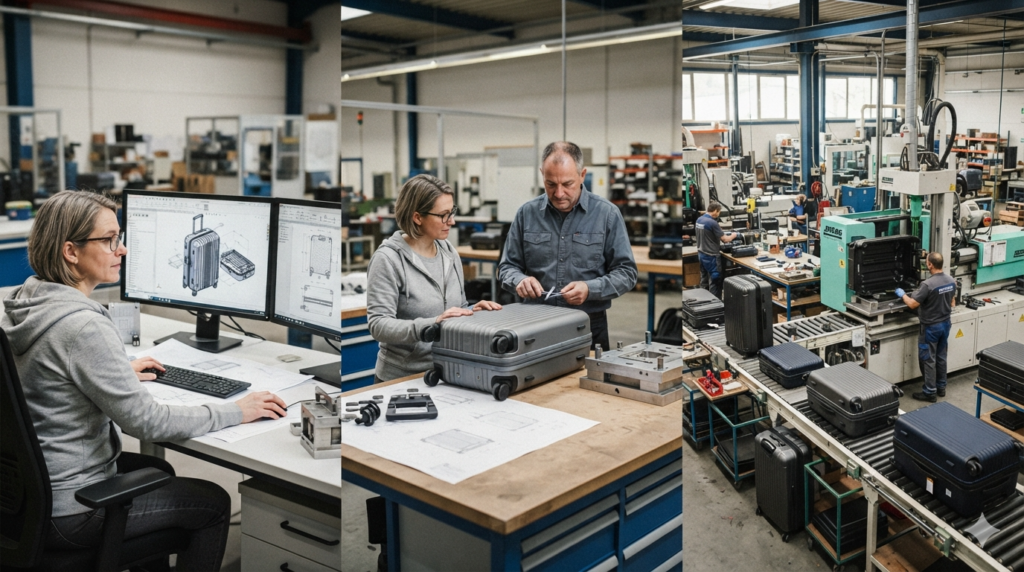
CAD ≠ Production Ready
Why a Finished CAD Drawing Is Only the Beginning
A finished CAD drawing can show exactly how a suitcase is intended to look. It does not necessarily show how that suitcase should be manufactured.
This distinction is one of the most important things to understand when developing custom luggage.
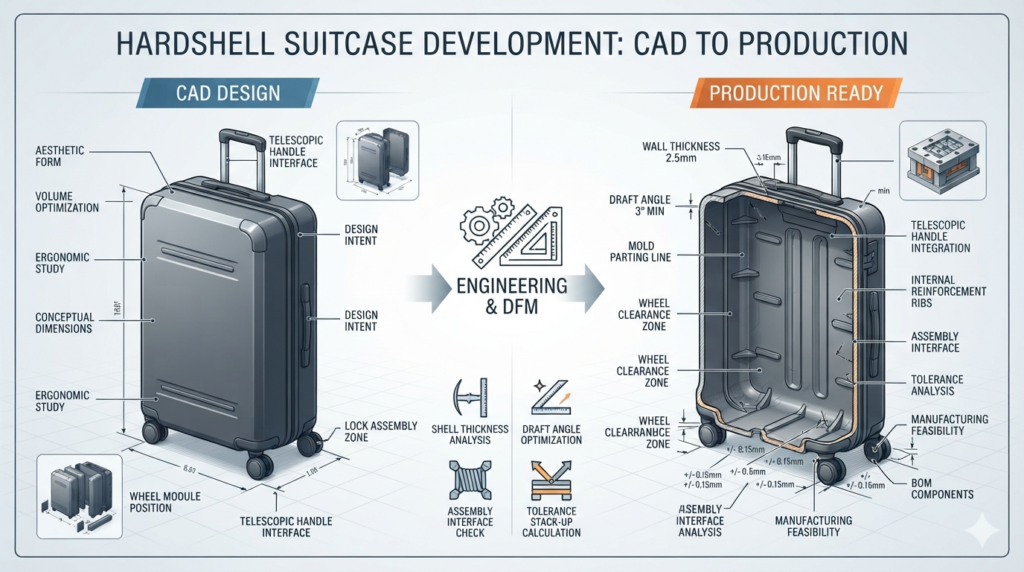
A CAD model describes the design intent: the shape, dimensions, proportions, component positions and overall appearance of the product.
Production engineering has a different job. It translates that design intent into a product that can be tooled, assembled, tested and manufactured consistently at scale.
That means a luggage manufacturer needs to look beyond the visible shape of the suitcase.
Design Definition vs. Production Definition
| Design Definition | Production Definition |
|---|---|
| Overall shape and appearance | Manufacturable structure |
| Product dimensions | Manufacturing tolerances |
| Component locations | Component clearance and interfaces |
| Material concept | Production-suitable material specification |
| Surface appearance | Tooling and finishing requirements |
| Functional concept | Validated mechanisms and assembly |
| Individual product design | Repeatable mass-production process |
Neither side replaces the other.
A strong design is the starting point. Engineering makes sure that the design can survive the realities of tooling, materials, assembly, testing and repeated production.
What Does a Manufacturer Review Before Production?
When a buyer sends a CAD package, the first step should not automatically be mold making.
The design needs to be reviewed against the intended manufacturing process and product requirements.
For a hard-shell suitcase, this may include questions such as:
- Is the shell geometry suitable for the selected manufacturing process?
- Is the wall structure appropriate for the intended application?
- Are the corners strong enough and practical to manufacture?
- Are there sufficient draft angles for tooling?
- Where should the parting line be located?
- Is there enough clearance for wheels, handles, locks and other components?
- Can the internal components be assembled efficiently?
- Are the selected materials compatible with the required surface finish?
- Can the product meet its target weight without compromising structure?
- Can the design be tested and inspected consistently?
These questions are especially important when the product includes custom components or an unusual structure.
A suitcase may look simple from the outside, but its shell, wheel system, telescopic handle, lock, zipper or frame, interior structure and branding details all have to work together.
The Gap Between “Looks Right” and “Works in Production”
One of the most common development gaps occurs when a design is evaluated primarily from a visual perspective.
A designer may focus on:
Shape → Proportion → Color → Surface → Brand Identity
An engineer must also consider:
Tooling → Material Behavior → Tolerance → Assembly → Strength → Testing → Repeatability
Both perspectives matter.
For example, a deep curve may create a distinctive silhouette but make tooling more complicated. A very tight corner radius may look refined but create structural or manufacturing challenges. A wheel housing designed without sufficient internal clearance may interfere with the lining or internal structure.
These issues do not necessarily mean the original design is wrong.
They mean the design needs to be translated into a production solution.
Why DFM Should Happen Before Tooling
This is where Design for Manufacturing (DFM) becomes critical.
DFM is the process of reviewing a product design with the actual manufacturing process in mind.
For luggage, a DFM review may examine:
Shell Geometry
Can the shell be formed or molded reliably while maintaining the intended appearance and strength?
Wall Thickness
Is the structure suitable for the selected material and production process?
Draft Angles
Can the finished part be released from the tooling without damaging the product or mold?
Parting Lines
Can the mold split be positioned in a way that balances appearance, tooling requirements and assembly?
Component Clearance
Do the wheels, handle, lock, zipper, lining and internal reinforcement have enough space to function correctly?
Assembly
Can the product be assembled efficiently and consistently by the production team?
Tolerance
Which dimensions are critical, and how much variation can the product realistically accept?
The objective is not to redesign a product simply for the convenience of the factory.
The objective is to preserve the buyer’s design intent while making the product commercially manufacturable.
A Small Design Change Can Have a Large Production Impact
Consider a simple example.
A buyer changes the curvature of a suitcase corner to create a more distinctive appearance.
That change may affect:
Corner Geometry → Mold Structure → Shell Forming → Component Clearance → Assembly → Testing
This is why design changes should be evaluated as part of the entire product system rather than as isolated visual modifications.
The earlier a potential issue is identified, the easier it is usually to address.
Once tooling has been completed, changes can become significantly more complicated because they may involve mold modification, new samples, additional testing or production schedule adjustments.
The Real Definition of Production Ready
A luggage design is closer to production-ready when the key questions have been answered:
What are we making?
The product structure, dimensions and specifications are clearly defined.
How will we make it?
The manufacturing process and tooling approach are understood.
What will we make it from?
Materials and components have been selected and validated.
How will we know it works?
Testing and functional requirements are defined.
How will we keep every unit consistent?
Quality standards, tolerances and inspection criteria are established.
That is the difference between a CAD file and a production-ready product definition.
A CAD model defines what the product should look like. Engineering determines how it can actually be produced.
The next stage is where this transition begins in practice: Engineering & DFM Review.
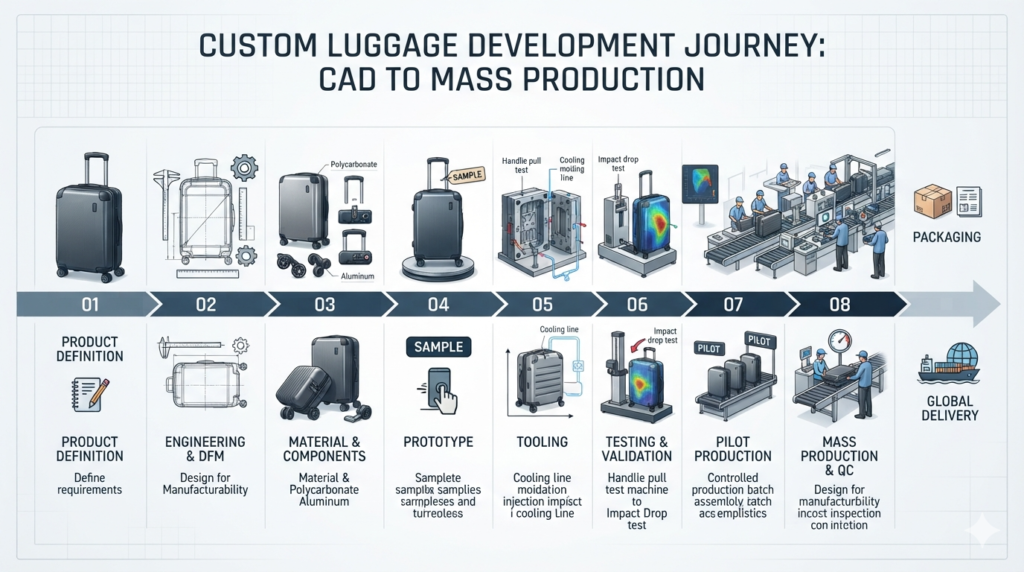
The Complete 8-Stage Journey
From CAD Drawing to Mass Production
Once a luggage design moves beyond the initial CAD review, the project becomes a structured product development process.
Although every custom luggage project has its own requirements, most successful developments follow a similar sequence. The exact timeline, number of revisions and manufacturing methods may vary, but the logic remains the same:
Define the product → Make the design manufacturable → Validate the materials and components → Build a physical prototype → Develop the tooling → Test the product → Confirm production readiness → Scale into mass production.
Here is the complete journey.
01 — Product Definition
Before engineering begins, the product needs to be clearly defined.
This includes the luggage size, dimensions, capacity, shell material, opening structure, wheel system, telescopic handle, lock, zipper or frame, interior, branding, colors, surface finish and packaging requirements.
The clearer the product definition, the easier it is for engineering and manufacturing teams to work from the same specification.
02 — Engineering & DFM
The next step is to determine whether the design can be manufactured reliably.
Engineers review shell geometry, wall structure, draft angles, parting lines, component clearance, assembly methods, tolerances and other manufacturing considerations.
The objective is to identify potential production issues before tooling begins.
03 — Material & Component Selection
A luggage product is more than its shell.
The material selection process may involve ABS, PC, PC/ABS, aluminum or other suitable materials, depending on the product concept and performance requirements.
At the same time, critical components such as wheels, telescopic handles, locks, zippers, lining and hardware need to be selected and matched to the overall design.
The goal is not simply to choose individual parts. It is to create a complete system that works together.
04 — Prototype Development
The first physical prototype turns the digital design into something that can be handled, inspected and tested.
This is where buyers and engineering teams can evaluate details that are difficult to judge from a screen alone:
Shape → Proportion → Ergonomics → Component Fit → Function → Appearance
The prototype stage may lead to revisions before the design is approved for tooling.
05 — Tooling & Mold Development
Once the design and prototype have been sufficiently validated, tooling can begin.
For molded luggage, the tooling determines much of the shell’s final geometry, surface quality and production repeatability.
The mold development process typically includes tool design, machining, assembly, trial production, measurement and necessary modifications.
Tooling should be treated as part of the product development process—not simply as a one-time manufacturing expense.
06 — Testing & Validation
A suitcase must work in real-world conditions, not just look correct.
Depending on the product requirements, validation may include drop testing, wheel durability, rolling performance, telescopic handle strength, zipper performance, load testing, lock function and surface durability.
Testing provides evidence that the approved design can meet its intended performance requirements before larger-scale production.
07 — Pilot Production
A successful prototype does not automatically guarantee a successful production run.
Pilot production bridges the gap between “the product works” and “the product can be produced consistently.”
The pilot run allows the manufacturing team to verify materials, tooling, assembly methods, production parameters, quality standards and workflow before full-scale production.
It is also an opportunity to identify problems that may not appear during prototype development.
08 — Mass Production & Quality Control
Once the product, tooling, materials, processes and quality requirements have been approved, the project can move into mass production.
At this stage, the focus shifts from developing one good suitcase to producing hundreds or thousands of consistent units.
Quality control therefore becomes an ongoing process, including material inspection, in-process checks, functional inspection and final inspection.
The finished products then move into packaging, container loading and global delivery.
How the 8 Stages Connect
These stages should not be viewed as eight completely separate tasks.
They form a connected development system:
Product Definition
↓
Engineering & DFM
↓
Material & Component Selection
↓
Prototype
↓
Tooling
↓
Testing & Validation
↓
Pilot Production
↓
Mass Production & QC
A decision made early in the process can affect several later stages.
For example:
Material Selection can affect → tooling, weight, surface finish and testing.
Shell Geometry can affect → DFM, mold design, structural strength and assembly.
Component Selection can affect → internal structure, clearance, weight and production assembly.
Packaging Design can affect → carton dimensions, loading efficiency and logistics cost.
This is why custom luggage development works best as a coordinated process rather than a series of isolated manufacturing steps.
Where Should Buyers Pay the Most Attention?
Not every stage requires the same level of buyer involvement.
In general, buyers should pay particular attention to the points where decisions become difficult or expensive to reverse:
Before Tooling
Confirm the design, structure, materials, components and critical specifications.
Before Prototype Approval
Check appearance, dimensions, functionality, ergonomics and component compatibility.
Before Mass Production
Confirm the final sample, testing requirements, QC standards, packaging and production specifications.
The principle is simple:
Make important decisions early—before they become expensive changes later.
The following sections will take a closer look at each stage, starting with the first question every manufacturer needs to answer:
What exactly are we producing?
if you have any luggage requirements and let me know freely 🙂 you could directly contact me and i will do arrange well for you
welcome you contact us Contact Us