
Sourcing luggage can look deceptively simple.
You compare a few supplier quotations, choose a material, approve a sample, and place an order. But in practice, many of the most expensive sourcing mistakes happen before production even begins.
A suitcase may have an attractive unit price but use materials that are unsuitable for the target market. A supplier may provide an impressive sample but struggle to maintain the same quality during mass production. A seemingly low-cost order may also become much more expensive after freight, packaging, defects, inspections, duties, and delays are included.
The problem is that these costs are often invisible when buyers focus on the quotation alone.
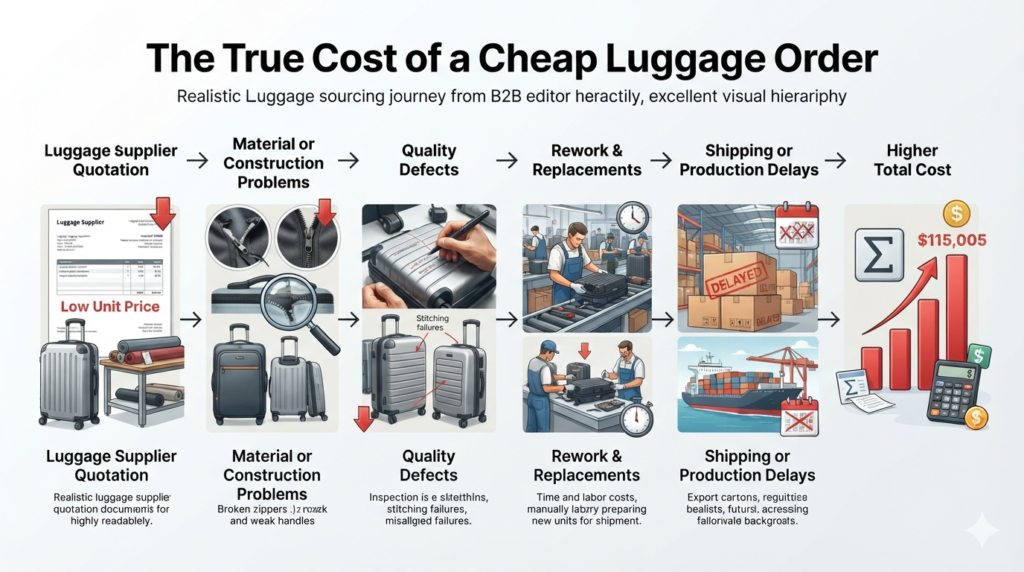
The Real Cost of a “Cheap” Luggage Order
Low Unit Price
↓
Material or Construction Problems
↓
Quality Defects
↓
Rework & Replacements
↓
Shipping or Production Delays
↓
Higher Total Cost
This is why successful luggage sourcing is not simply about finding the lowest factory price.
It is about making the right decisions at three critical stages:
1. Specify the Right Product
Before asking suppliers for prices, you need to clearly define the product: its target customer, usage scenario, dimensions, materials, construction, hardware, testing requirements, and market positioning.
2. Verify the Right Supplier
A competitive quotation does not automatically mean a supplier is capable of delivering your product consistently. You need to evaluate production capabilities, quality systems, samples, MOQ, customization capabilities, and communication before placing an order.
3. Calculate the Real Cost
The quoted unit price is only one part of your sourcing cost. Packaging, freight, duties, inspection, defects, returns, delays, and other supply-chain expenses can significantly change the final economics of an order.
In other words:
The cheapest quotation is not necessarily the lowest sourcing cost.
This guide breaks the luggage sourcing process into three practical steps—Specify, Verify, and Calculate—so you can identify potential problems earlier, compare suppliers more intelligently, and make sourcing decisions based on the total value and risk, not just the number on a quotation.
Guide 1: Specify the Right Luggage Before You Ask for a Price
One of the most common mistakes in luggage sourcing is asking suppliers for a quotation before the product has been properly defined.
A request such as:
“Please quote a 20-inch suitcase in PC.”
may sound specific enough. In reality, it leaves dozens of important questions unanswered.
What are the finished exterior dimensions? Does the measurement include the wheels and telescopic handle? What is the target empty weight? Which grade of PC is required? What type of wheels, handle, zipper and lock should be used? What level of durability is expected?
Without clear answers, different suppliers may quote different products under the same product name.
That creates a dangerous situation: the lowest quotation may simply belong to the supplier offering the lowest specification.
A better sourcing process starts with the product itself.
1. Start With the End User, Not the Supplier
Before discussing materials or prices, define who will use the luggage and how they will use it.
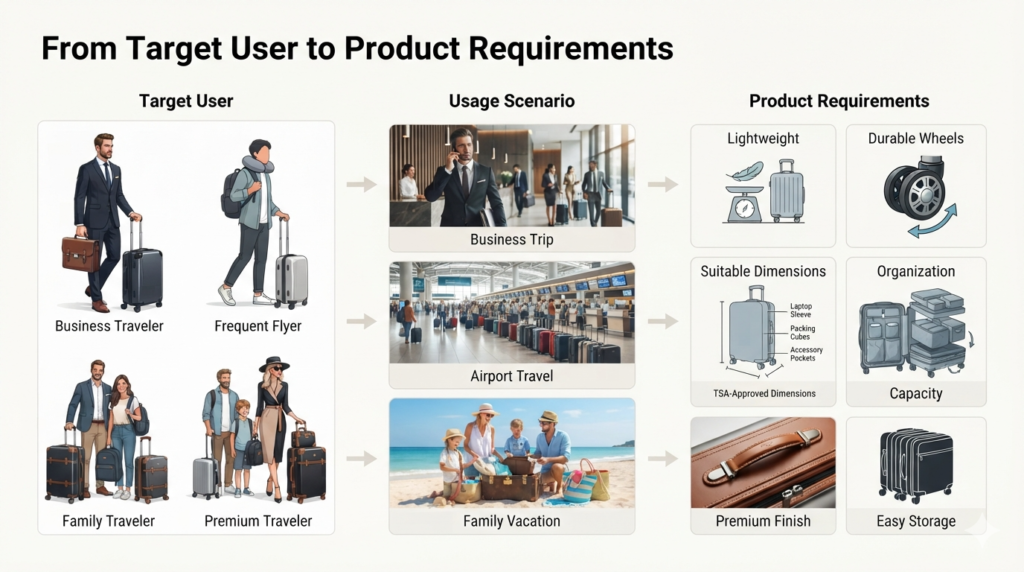
A business traveler may prioritize lightweight construction, laptop organization and a professional appearance. A family traveler may care more about capacity, durability and easy organization. A frequent flyer may place greater importance on wheel durability, reinforced construction and airline-friendly dimensions.
The same basic suitcase category can therefore require very different specifications depending on its intended user.
Match the User to the Product Requirements
| Target User | Typical Usage | Key Product Priorities |
|---|---|---|
| Business Travelers | Short business trips | Lightweight, organization, professional appearance |
| Frequent Flyers | Regular air travel | Durable wheels, reinforced construction, suitable dimensions |
| Families | Longer vacations | Capacity, durability, easy organization |
| Students | Travel + daily use | Lightweight, practical storage, value |
| Premium Travelers | Frequent leisure/business travel | Materials, hardware, finish, functionality |
| Value-Oriented Consumers | Occasional travel | Competitive cost, acceptable durability |
The important point is not to choose one category simply because it is popular.
Instead, ask:
What problem is this luggage supposed to solve for the customer?
That answer should influence almost every decision that follows.
📊 Visual Recommendation — User → Usage → Product Requirements
Placement: Immediately after the above section.
The infographic should visually connect:
Target User → Usage Scenario → Product Requirements
For example:
Frequent Flyer
→ Airline Travel
→ Lightweight + Durable Wheels + Suitable Dimensions
Business Traveler
→ Short Business Trips
→ Organization + Laptop Storage + Professional Appearance
Family Traveler
→ Long Vacation
→ Capacity + Durability + Easy Organization
2. Build a Complete Product Specification Before Requesting Quotes
Once the target user and application are clear, the next step is to translate those requirements into a production-ready product specification.
This is where many sourcing projects go wrong.
Buyers often provide a product name, a reference image and a target price, then expect suppliers to fill in the rest.
That can work for a simple stock product.
For customized luggage, however, every undefined detail creates room for different interpretations.
A professional RFQ should ideally define at least the following:
| Specification | What the Buyer Should Define |
|---|---|
| Product Type | Carry-on, checked luggage, duffel, backpack, etc. |
| Size | Exact finished dimensions |
| Weight | Target empty weight |
| Capacity | Target internal volume |
| Main Material | Material type and construction |
| Lining | Material and durability requirements |
| Wheels | Type, size, material and configuration |
| Telescopic Handle | Structure, stages and finish |
| Lock | TSA / combination / other requirement |
| Zippers | Size, construction and quality level |
| Interior | Dividers, pockets, straps and compartments |
| Reinforcement | Corners, frame, bottom, handle attachment |
| Branding | Logo method and placement |
| Packaging | Individual packaging and export carton requirements |
The more precisely these elements are defined, the easier it becomes to compare supplier quotations on an apples-to-apples basis.
💡 Expert Tip
A quotation is only as comparable as the specifications behind it.
If Supplier A and Supplier B are quoting different materials, hardware or construction methods, comparing their prices alone can be misleading.
3. Don’t Confuse a “20-Inch” Luggage Category With Its Actual Dimensions
One particularly common example is carry-on luggage.
A buyer may ask for a:
“20-inch carry-on.”
But the term “20-inch” does not necessarily tell you the product’s actual finished exterior dimensions.
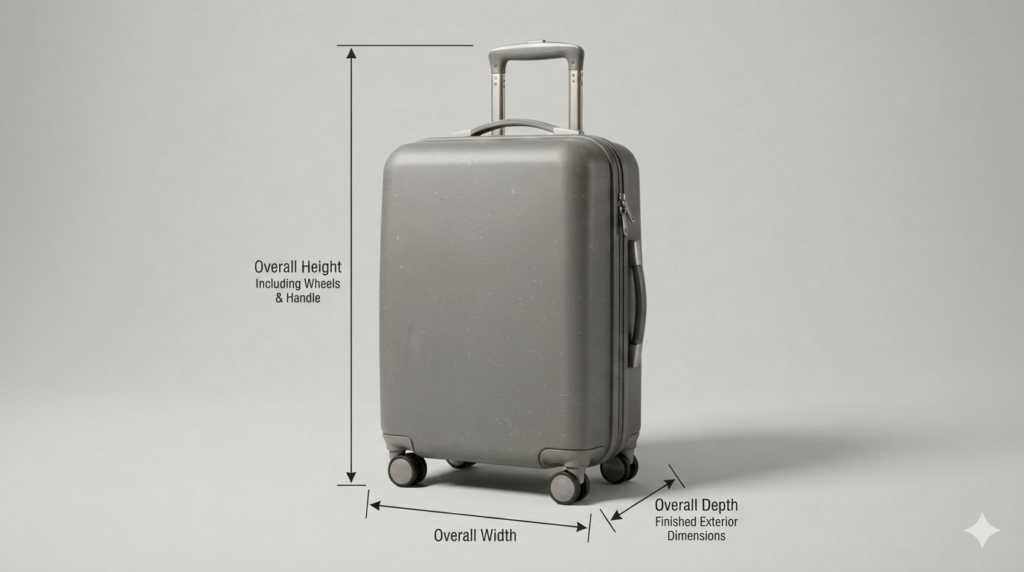
For airline travel, what matters is the actual outside measurement of the finished product.
Depending on the product design, the overall dimensions may include:
- Wheels
- Telescopic handle
- Top handle
- Side handle
- Fixed exterior components
- Protective corners or other protruding parts
Therefore, a proper specification should state something such as:
Finished exterior dimensions: including wheels, handles and all fixed components.
This distinction becomes particularly important when a product is intended for airline carry-on use.
🖼️ Visual Recommendation — Carry-On Dimension Reference
The image should show a real suitcase rather than a generic diagram.
Recommended annotations:
- Overall Height
- Overall Width
- Overall Depth
- Including Wheels
- Including Handle
4. Choose Materials Based on Performance, Not Appearance
Material selection is another area where buyers can easily make an expensive mistake.
A fabric may look attractive in a showroom or product photo but still be unsuitable for the intended application.
Likewise, choosing a material simply because a supplier says it is “high quality” does not provide enough information.
For soft luggage and travel bags, one common comparison is Nylon vs. Polyester.
Nylon vs. Polyester
| Factor | Nylon | Polyester |
|---|---|---|
| Strength | Generally higher | Generally lower |
| Abrasion Resistance | Generally strong | Good |
| Weight | Often lighter | Often heavier |
| Cost | Usually higher | Usually lower |
| Common Positioning | Premium / performance | Mainstream / value |
| Typical Consideration | Durability and lightweight performance | Cost efficiency and general durability |
However, neither material is automatically the “best” choice.
The right question is:
Which material provides the required performance at the target price and for the intended application?
For example, a premium lightweight travel product may justify a higher-cost nylon fabric, while a value-oriented retail product may achieve a better balance with polyester.
💡 Expert Tip
When evaluating a material, don’t ask only:
“What material is this?”
Also ask:
“Why is this material appropriate for this product?”
That second question often reveals much more about a supplier’s technical understanding.
5. Understand Denier, Fabric Construction and Coatings
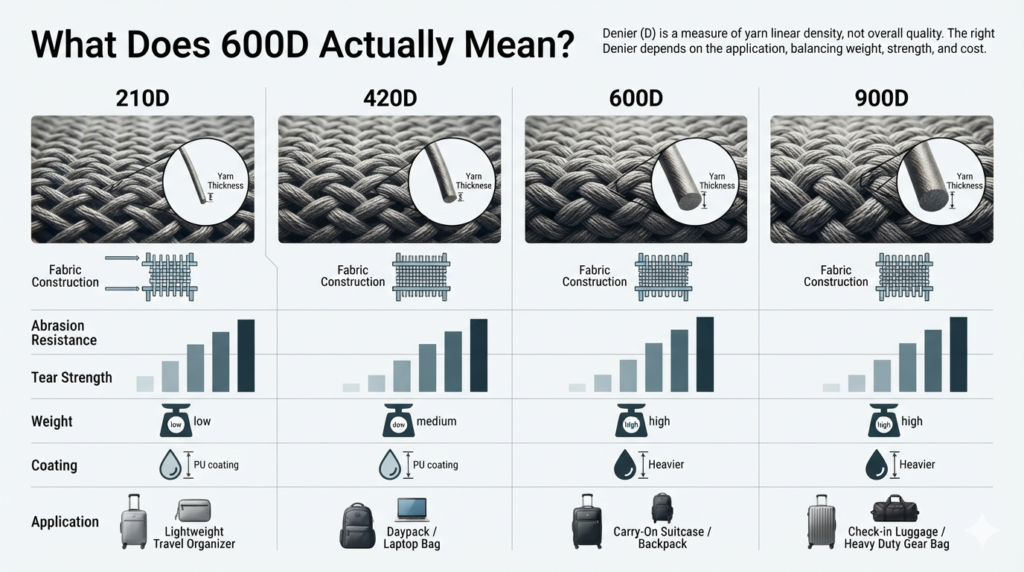
Another common mistake is treating denier as a simple quality ranking.
A buyer may assume:
900D must be better than 600D, and 600D must be better than 420D.
But fabric performance is more complicated than that.
Denier generally describes the linear density of the yarn. It does not, by itself, determine the overall performance of a finished fabric.
Other factors can include:
- Yarn quality
- Weave construction
- Fabric density
- Coating
- Tear strength
- Abrasion resistance
- Flexibility
- Weight
- Intended application
For this reason, a lighter fabric may be the better choice for one luggage product, while a heavier construction may be more appropriate for another.
📊 Visual Recommendation — What Does 600D Actually Mean?
This should be a technical educational infographic rather than a decorative graphic.
It should compare:
210D → 420D → 600D → 900D
while clearly communicating:
Higher denier does not automatically mean better luggage fabric.
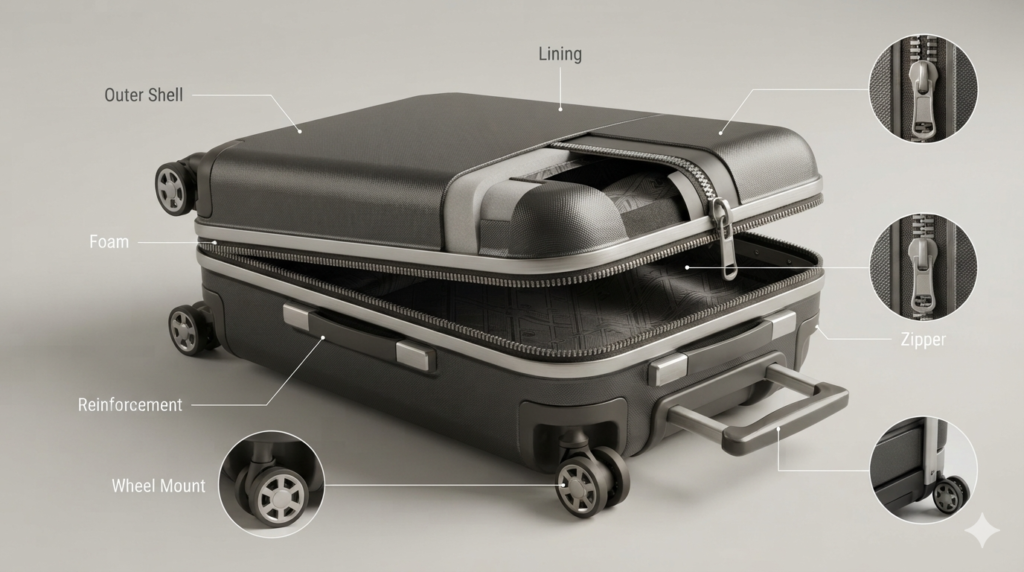
6. Don’t Ignore the Inside of the Luggage
A luggage product can look excellent on the outside and still have serious construction weaknesses inside.
This is particularly important for:
- Lining
- Foam
- Reinforcement boards
- Internal frames
- Corner reinforcement
- Handle mounting
- Wheel mounting
- Interior dividers
- Zipper construction
For example, the external fabric or shell may be highly durable, but a weak handle attachment or poorly reinforced wheel area can still cause product failure.
The same principle applies to comfort-focused travel bags.
The shoulder straps and back panel may depend on:
- Foam density
- Foam type
- EPE vs. EVA
- Structural reinforcement
- Stitching
- Load distribution
Therefore, when reviewing a sample, buyers should inspect the internal construction—not just the appearance.
🖼️ Visual Recommendation — Luggage Internal Structure
This image should function almost like a technical product X-ray.
It should reveal:
Outer Shell → Lining → Foam → Reinforcement → Frame → Zipper → Wheel Mount → Handle Connection
7. Match Materials to Climate and Usage Conditions
A material that performs well in one market may not necessarily perform equally well in another.
This becomes especially important when luggage is sold internationally.
Buyers should consider:
- Temperature
- Humidity
- UV exposure
- Rain and moisture
- Abrasion
- Frequency of use
- Storage conditions
- Transportation environment
For coated fabrics, for example, the choice between PU and PVC should not be made based on price alone.
Depending on the application, buyers may need to consider:
- Flexibility
- Cold-temperature performance
- Heat exposure
- UV resistance
- Coating durability
- Water resistance
- Long-term appearance
📋 Climate & Material Risk Table
| Environment | Potential Risk | What to Evaluate |
|---|---|---|
| Cold Climate | Coating may become less flexible | Low-temperature performance |
| Hot Climate | Material/coating degradation | Heat resistance |
| High UV Exposure | Color or material degradation | UV resistance |
| Humid Environment | Moisture-related issues | Water resistance |
| Heavy Use | Abrasion and tearing | Abrasion & tear resistance |
The key is to match material performance to the actual selling environment, rather than choosing materials based solely on appearance or supplier preference.
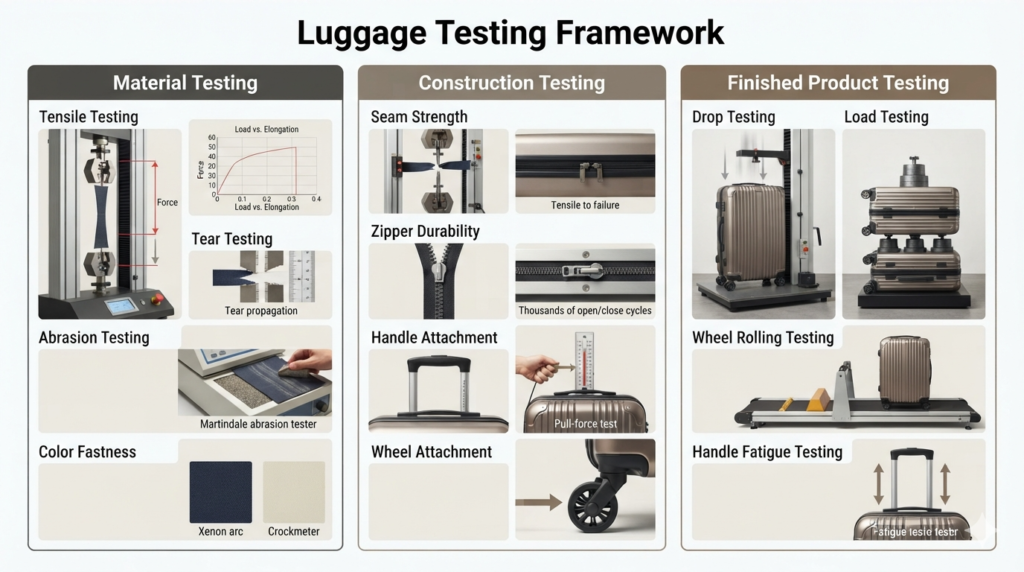
8. Define Testing Requirements Before Mass Production
Testing should not be something discussed only after a quality problem appears.
A stronger approach is to define the required performance before mass production begins.
Testing can be considered at three levels.
Material Testing
- Tensile strength
- Tear strength
- Abrasion resistance
- Color fastness
- Coating adhesion
Construction Testing
- Seam strength
- Stitching strength
- Zipper durability
- Handle attachment
- Wheel attachment
Finished Product Testing
- Drop testing
- Load testing
- Wheel rolling
- Handle fatigue
- Zipper cycling
- Functional testing
For luggage, finished-product testing is especially important because individual components can perform well independently but fail when assembled into a complete product.
📊 Visual Recommendation — Luggage Testing Framework
💡 Expert Tip
A material specification without a testing method is incomplete.
9. Guide 1 Quick Takeaway
Before requesting a luggage quotation, make sure you can answer these questions:
Product Definition Checklist
- Who is the target customer?
- What is the main usage scenario?
- What exact product type is required?
- What are the finished exterior dimensions?
- Do the dimensions include wheels and handles?
- What is the target empty weight?
- What is the target capacity?
- What materials are required?
- What hardware is required?
- What internal construction is required?
- What durability level is expected?
- What testing is required?
- Which market will the product be sold in?
If these questions cannot yet be answered, it may be too early to compare supplier quotations.
The first step in successful luggage sourcing is not finding a lower price. It is defining exactly what you are buying.
Guide 1: Specify the Right Luggage Before You Ask for a Price
One of the most common mistakes in luggage sourcing is asking suppliers for a quotation before the product has been properly defined.
A request such as:
“Please quote a 20-inch suitcase in PC.”
may sound specific enough. In reality, it leaves dozens of important questions unanswered.
What are the finished exterior dimensions? Does the measurement include the wheels and telescopic handle? What is the target empty weight? Which grade of PC is required? What type of wheels, handle, zipper and lock should be used? What level of durability is expected?
Without clear answers, different suppliers may quote different products under the same product name.
That creates a dangerous situation: the lowest quotation may simply belong to the supplier offering the lowest specification.
A better sourcing process starts with the product itself.
1. Start With the End User, Not the Supplier
Before discussing materials or prices, define who will use the luggage and how they will use it.
A business traveler may prioritize lightweight construction, laptop organization and a professional appearance. A family traveler may care more about capacity, durability and easy organization. A frequent flyer may place greater importance on wheel durability, reinforced construction and airline-friendly dimensions.
The same basic suitcase category can therefore require very different specifications depending on its intended user.
Match the User to the Product Requirements
| Target User | Typical Usage | Key Product Priorities |
|---|---|---|
| Business Travelers | Short business trips | Lightweight, organization, professional appearance |
| Frequent Flyers | Regular air travel | Durable wheels, reinforced construction, suitable dimensions |
| Families | Longer vacations | Capacity, durability, easy organization |
| Students | Travel + daily use | Lightweight, practical storage, value |
| Premium Travelers | Frequent leisure/business travel | Materials, hardware, finish, functionality |
| Value-Oriented Consumers | Occasional travel | Competitive cost, acceptable durability |
The important point is not to choose one category simply because it is popular.
Instead, ask:
What problem is this luggage supposed to solve for the customer?
That answer should influence almost every decision that follows.
📊 Visual Recommendation — User → Usage → Product Requirements
Placement: Immediately after the above section.
The infographic should visually connect:
Target User → Usage Scenario → Product Requirements
For example:
Frequent Flyer
→ Airline Travel
→ Lightweight + Durable Wheels + Suitable Dimensions
Business Traveler
→ Short Business Trips
→ Organization + Laptop Storage + Professional Appearance
Family Traveler
→ Long Vacation
→ Capacity + Durability + Easy Organization
Guide 2: Verify the Right Supplier Before You Trust the Quotation
Once your product specifications are clear, the next challenge is finding a supplier that can actually deliver them.
This is where many sourcing projects take a wrong turn.
A supplier may have an attractive website, a professional product catalog and a very competitive quotation. But none of these things proves that the supplier has the production capability, quality system or supply-chain control required for your project.
The real question is not simply:
“Is this a factory?”
It is:
“Can this supplier consistently manufacture my product to the required specification, quality level and delivery schedule?”
1. Factory or Trading Company? Look Beyond the Label
The distinction between a manufacturer and a trading company can be useful, but it should not become the only criterion in your supplier evaluation.
A capable trading company may have strong product development and supply-chain management capabilities, while a factory may have excellent production equipment but limited experience with international buyers or customized projects.
Instead of focusing only on the label, evaluate the supplier’s ability to control the complete process.
Look at:
- Product development capability
- Relevant manufacturing experience
- Production location
- Equipment
- Quality-control procedures
- Material management
- Customization capability
- Production capacity
- Export experience
- Communication and project management
The key question:
Can the supplier provide evidence that its capabilities match your requirements?
A supplier who can clearly demonstrate its production process is generally easier to evaluate than one that relies mainly on marketing claims.
2. Don’t Judge a Supplier by Its Website
A professional website can be useful for understanding a supplier’s product range and positioning.
But a website is not a factory audit.
Statements such as:
- “High quality”
- “Professional manufacturer”
- “Advanced factory”
- “Competitive price”
- “Fast delivery”
- “Experienced team”
are easy to write.
The important question is:
What evidence supports these claims?
Supplier Claims vs. Buyer Verification
| Supplier Says | Buyer Should Verify |
|---|---|
| “We are a factory.” | Production location and manufacturing evidence |
| “High quality.” | QC procedures and inspection records |
| “Professional manufacturer.” | Relevant product experience |
| “Strong production capacity.” | Equipment, workforce and production process |
| “Fast delivery.” | Actual production lead-time process |
| “Competitive pricing.” | Specification and BOM comparison |
| “Excellent materials.” | Material specifications and test evidence |
| “We can customize.” | Previous customization examples and development process |
This approach helps buyers move from trusting statements to verifying capabilities.
💡 Expert Tip
Ask for evidence, not adjectives.
3. Check Whether the Supplier Can Actually Make Your Product
A supplier may be experienced in luggage manufacturing but still be unsuitable for your particular project.
For example, a supplier specializing in standard soft luggage may not have the right capabilities for:
- Complex hard-shell construction
- Full-surface printing
- Custom molds
- Special hardware
- Advanced lamination
- Waterproof construction
- Custom wheel systems
- Specialized interior structures
Before placing an order, compare your product requirements against the supplier’s actual capabilities.
Product Requirement vs. Supplier Capability
| Your Requirement | What to Verify |
|---|---|
| Hard-shell luggage | Shell material and molding capability |
| Soft luggage | Cutting, sewing and reinforcement capability |
| Custom printing | Printing method and production experience |
| Custom hardware | Tooling and hardware development |
| Special wheels | Wheel sourcing and assembly capability |
| Custom handle | Handle development and testing |
| Waterproof construction | Lamination, welding or seam-sealing capability |
| Premium interior | Lining, foam and structural construction |
| Large-volume production | Production capacity and scheduling |
| Retail-ready packaging | Packaging development and export experience |
The closer the supplier’s existing capabilities are to your actual product requirements, the lower the execution risk.
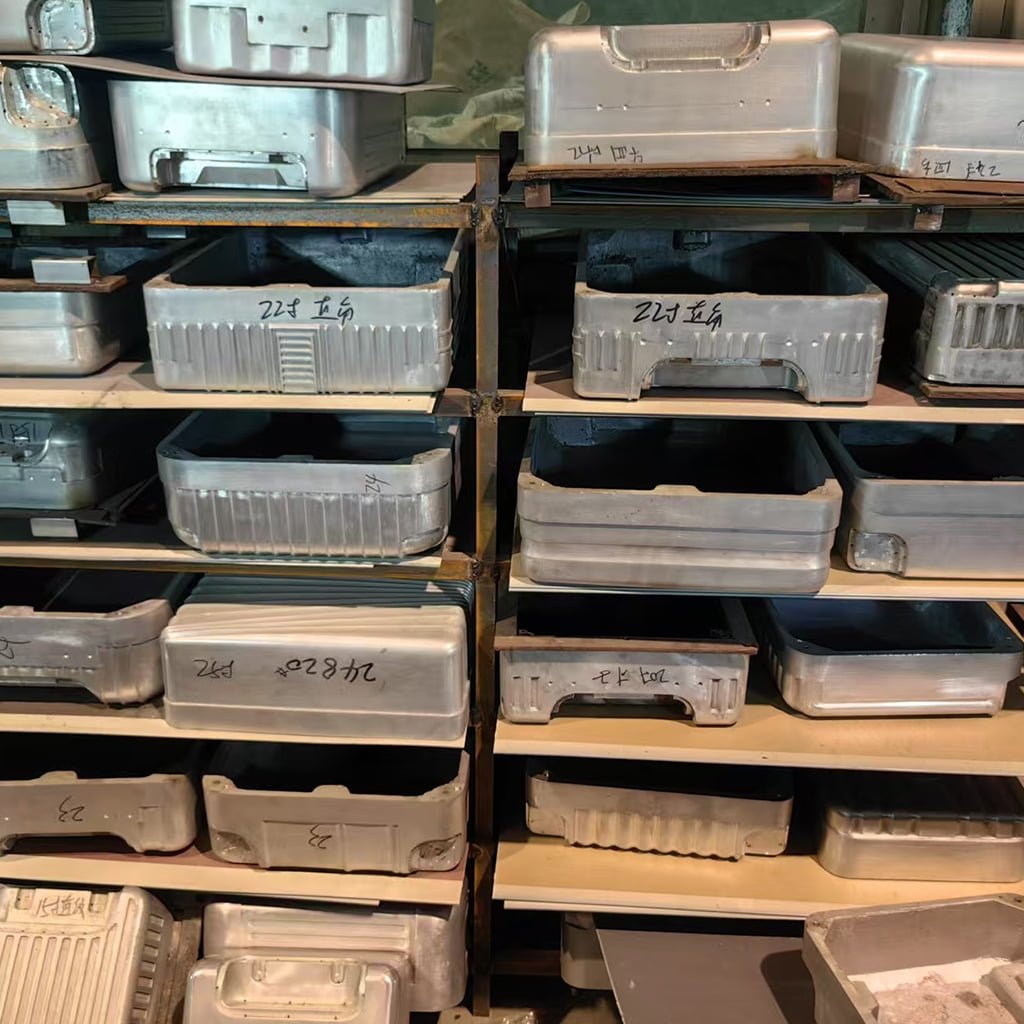
4. Production Equipment Can Reveal More Than a Brochure
When evaluating a manufacturer, production equipment can provide useful evidence of what the factory is actually capable of producing.
Depending on the product, relevant equipment may include:
- Computerized sewing machines
- Bartacking machines
- Programmable pattern sewing machines
- Automatic cutting equipment
- Fabric testing equipment
- Printing equipment
- Lamination equipment
- Ultrasonic welding equipment
- High-frequency welding equipment
- Assembly equipment
The important point is not to create a checklist of expensive machines simply for appearance.
Instead, ask:
Does the equipment support the specific construction and quality requirements of my product?
For example, a factory producing waterproof luggage may require very different equipment and processes from one producing conventional fabric travel bags.
🖼️ Visual Recommendation — Real Luggage Factory
This should be a realistic documentary-style factory photograph, not a polished factory advertisement.

5. Use the Sample as a Supplier Verification Tool
A sample should not be treated only as a visual preview.
It is an opportunity to test whether the supplier understands your requirements and can translate specifications into a physical product.
When reviewing the sample, check at least:
Product Dimensions
- Overall dimensions
- Individual components
- Weight
- Capacity
Materials
- Main material
- Lining
- Foam
- Reinforcement
- Hardware
Construction
- Stitching
- Seams
- Reinforcement
- Zippers
- Handles
- Wheels
- Locks
Function
- Opening and closing
- Wheel rolling
- Handle extension
- Interior organization
- Load-bearing performance
Appearance
- Color
- Surface finish
- Logo
- Printing
- Symmetry
- Assembly quality
A strong supplier should also be able to explain why the sample was constructed that way, not simply tell you that it “looks good.”
6. Ask the Supplier to Explain the Sample—Not Just Send It
This is an often-overlooked part of supplier evaluation.
During sample review, ask questions such as:
- Why was this material selected?
- Why was this wheel size chosen?
- How is the handle reinforced?
- What prevents the zipper from separating?
- Where are the major stress points?
- How will this construction be controlled during mass production?
- Which components may change because of MOQ or availability?
- What parts require special quality inspection?
The supplier’s answers can reveal its technical understanding.
A supplier that understands why a product is designed in a particular way is generally more valuable than one that simply follows a drawing without understanding the underlying requirements.
7. Sample Approval Does Not Guarantee Bulk Production
One of the most dangerous assumptions in sourcing is:
“The sample is perfect, so the bulk order will be perfect too.”
Not necessarily.
A sample is usually produced under controlled conditions with more attention per unit.
Mass production introduces additional variables:
- Different material batches
- Multiple production workers
- Production speed
- Component substitutions
- Assembly variation
- Equipment settings
- Quality-control consistency
Therefore, a professional sourcing process should establish a clear transition from approved sample to mass production.
Recommended Process
Initial Sample
↓
Buyer Review
↓
Sample Approval
↓
Pre-Production Confirmation
↓
Material Confirmation
↓
Production Reference Sample
↓
Mass Production
↓
QC Inspection
↓
Shipment
The goal is to make the approved sample a production reference, rather than simply treating it as a one-time prototype.
⚠️ Red Flag
Be cautious if a supplier says:
“Don’t worry. The bulk production will be exactly the same.”
but cannot explain:
- How materials are controlled
- How specifications are documented
- How production workers follow the approved sample
- How quality is inspected
- What happens when a component changes
A reliable production system should not depend entirely on verbal promises.
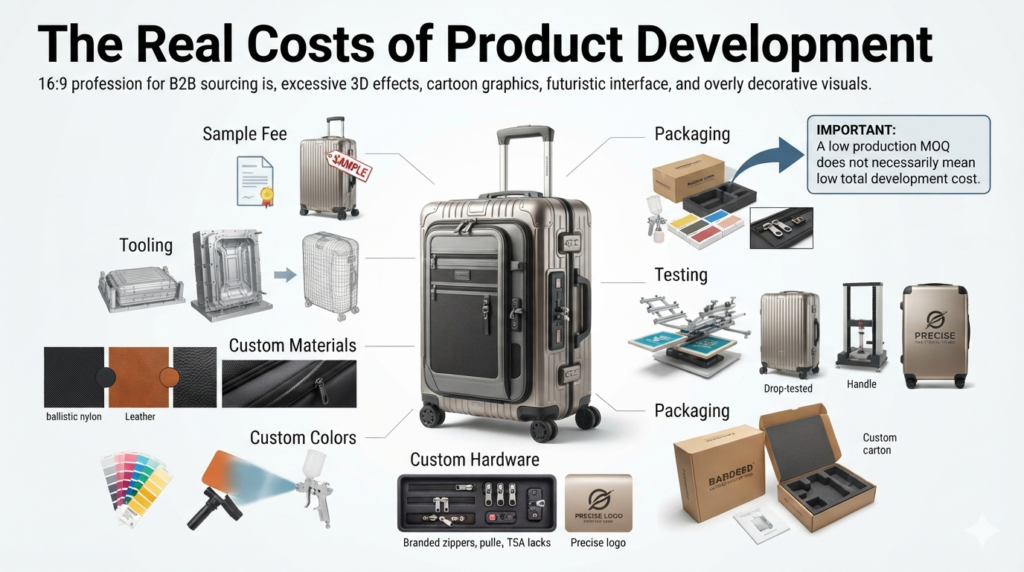
8. Understand MOQ and Hidden Development Costs
MOQ is more complicated than simply asking:
“What is your minimum order quantity?”
For customized luggage, the actual development cost may also include:
- Sample fees
- Mold/tooling
- Custom fabrics
- Custom colors
- Custom hardware
- Custom zippers
- Printing
- Logo development
- Packaging
- Testing
This means a supplier offering a low MOQ may still not be the most economical option if the development costs are significantly higher.
Example
A project with:
100 units
may sound small.
But if it requires:
- Custom fabric
- Custom color
- Custom hardware
- New tooling
- Special printing
- Custom packaging
the supplier may need to purchase materials in quantities much larger than the final order.
The right question is therefore not only:
“What is your MOQ?”
but also:
“What costs are triggered by my customization requirements?”
📊 Visual Recommendation — The Real Development Cost
9. Build a Supplier Evaluation Scorecard
Instead of choosing a supplier based on price alone, create a simple evaluation scorecard.
For example:
| Evaluation Area | Suggested Weight |
|---|---|
| Product Capability | 20% |
| Quality System | 20% |
| Price | 15% |
| MOQ | 10% |
| Lead Time | 10% |
| Customization | 10% |
| Compliance | 10% |
| Communication | 5% |
The exact weighting can vary depending on the project.
For a premium luggage launch, for example, product capability and quality may deserve more weight than unit price.
For a highly price-sensitive mass-market program, cost may receive greater importance.
The purpose of the scorecard is not to create a perfect mathematical model.
It is to prevent one attractive number—usually the quotation—from dominating the entire supplier decision.
10. Verify the Supplier Before You Scale the Order
For a new supplier, a sensible sourcing strategy is to increase commitment gradually.
A typical progression may look like:
Supplier Screening
↓
Sample Development
↓
Sample Evaluation
↓
Small / Trial Order
↓
Bulk Production
↓
Long-Term Cooperation
This approach allows buyers to identify problems before committing a large amount of inventory or working capital.
For long-term programs, buyers can then evaluate:
- Quality consistency
- Delivery reliability
- Communication
- Responsiveness
- Problem-solving
- Cost stability
- Capacity growth
The goal is not simply to find a supplier that can produce one good sample.
The goal is to identify a supplier that can become a reliable production partner.
11. Guide 2 Quick Checklist
Before trusting a luggage supplier, ask:
Supplier Verification Checklist
- Does the supplier have relevant luggage experience?
- Can they demonstrate actual production capability?
- Can they manufacture your specific product construction?
- Do their equipment and processes match your requirements?
- Can they explain their quality-control process?
- Can they provide relevant samples?
- Can they explain the technical decisions behind the sample?
- How will the approved sample be controlled during mass production?
- What is the actual MOQ for your customized product?
- What additional development costs should you expect?
- Can the supplier handle your required production volume?
- Can they maintain quality as your order volume increases?
The objective is simple:
Don’t choose a supplier because it looks convincing. Choose one because its capabilities have been verified.
Guide 3: Calculate the Real Cost Before Placing the Order
A supplier quotation may look attractive because the unit price is low. But the unit price is only one part of your actual sourcing cost.
For luggage buyers, the real cost of an order can also include:
- Freight and shipping
- Import duties and taxes
- Packaging
- Inspection and testing
- Defective or unsellable units
- Rework and replacement
- Warehousing
- Compliance costs
- Delays and missed selling opportunities
- Additional development or tooling costs
This is why two suppliers offering $25 and $28 per suitcase may not actually cost you $3 more per unit—or even be more expensive overall.
The right question is not:
“Which supplier has the lowest price?”
It is:
“Which supplier gives me the lowest reliable total cost?”
1. Unit Price Is Only the Starting Point
Imagine two suppliers quote the following:
| Cost Factor | Supplier A | Supplier B |
|---|---|---|
| Unit Price | $25.00 | $28.00 |
| Defect Rate | 5% | 1.5% |
| Packaging | Standard | Retail-ready |
| Quality Control | Basic | Pre-shipment inspection |
| Lead Time | 45 days | 32 days |
| Shipping Efficiency | Average | Better |
| Replacement Risk | Higher | Lower |
At first glance, Supplier A appears cheaper.
But if 5% of the products arrive defective, some units may need to be replaced, repaired, discounted, or written off.
If the shipment also arrives late, you may face:
- Missed promotional campaigns
- Stock shortages
- Additional air freight
- Customer complaints
- Lost sales
- Higher warehouse handling costs
The initial $3 difference may therefore be much less important than it appears.
Key principle
A low purchase price can become an expensive order when quality, logistics and reliability are poor.
2. Calculate Landed Cost, Not Just Factory Price
For international luggage sourcing, one of the most useful concepts is landed cost.
Landed cost represents the approximate total cost of getting the products from the supplier to your warehouse or designated destination.
A simplified formula is:
Landed Cost = Product Cost + Packaging + Inland Transportation + Freight + Duties/Taxes + Inspection + Other Import/Handling Costs
Depending on your business model, you may also want to include:
- Warehousing
- Financing costs
- Insurance
- Rework
- Defective products
- Replacement shipments
- Compliance/testing
- Customs-related costs
Example
Suppose you purchase 1,000 suitcases at $25 each:
Product cost = $25,000
But your actual sourcing expenditure might look more like:
- Product cost: $25,000
- Packaging: $800
- Inland transportation: $500
- Ocean freight: $3,000
- Inspection/testing: $400
- Duties and import-related costs: $2,500
- Other handling costs: $300
Estimated landed cost = $32,500
That means your effective landed cost is:
$32.50 per suitcase
—not $25.
The exact calculation will depend on your Incoterm, destination, tariff classification, freight method and local import requirements, but the principle remains the same:
Compare suppliers using comparable total costs, not isolated factory quotations.
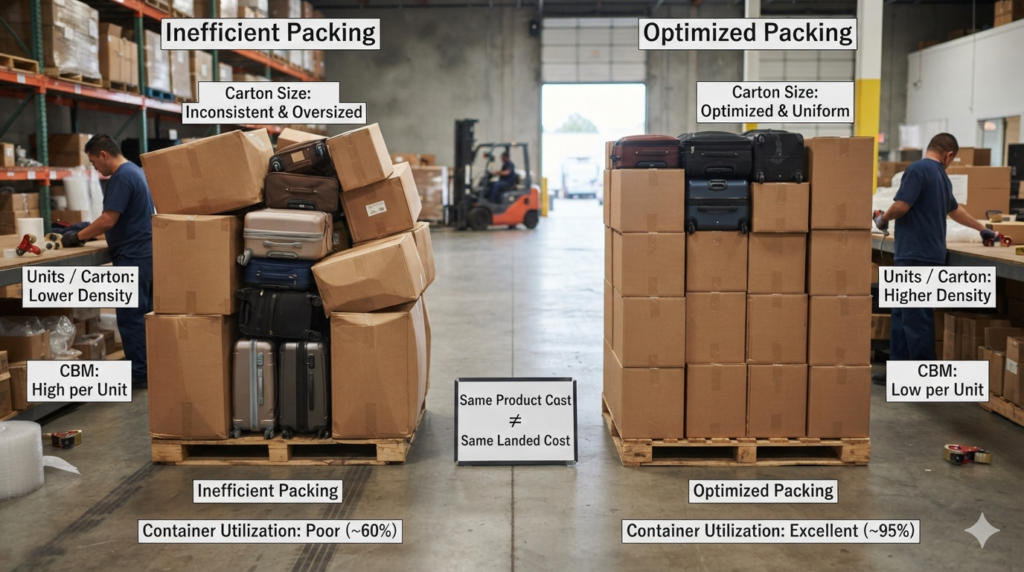
3. Shipping Efficiency Can Change Your Real Cost
Luggage is a relatively bulky product, so logistics efficiency can have a meaningful impact on your final cost.
Two products with identical factory prices can have very different landed costs because of:
- Carton dimensions
- Packing method
- Number of units per carton
- Carton utilization
- Product nesting
- Container utilization
- Gross and net weight
- Shipping route
- Shipping method
- Port or destination
- Seasonality of freight rates
For example, if one supplier packs luggage inefficiently, you may pay to ship a large amount of unused air inside cartons or containers.
What buyers should ask
Before placing a large order, ask the supplier for:
- Product dimensions
- Carton dimensions
- Units per carton
- Net weight
- Gross weight
- Carton CBM
- Total CBM
- Estimated container loading quantity
- Packaging specifications
This information allows you to compare the logistics efficiency of different suppliers.
Expert Tip
For bulky products such as luggage, packaging design is also a logistics decision.
A slightly more expensive product can sometimes have a lower landed cost if it uses space more efficiently.
4. Defect Rate Changes Your Effective Unit Cost
Another commonly overlooked cost is the defect rate.
Suppose you order 1,000 suitcases at $25 each.
If 5% are defective:
1,000 × 5% = 50 defective units
You may not be able to sell all 1,000 units at full value.
Depending on the defect, you may need to:
- Repair the products
- Replace components
- Rework the products
- Offer discounts
- Replace units for customers
- Dispose of damaged products
- Absorb return costs
The effective cost of the sellable units therefore becomes higher.
For example:
Total product expenditure = $25,000
If only 950 units are fully sellable:
$25,000 ÷ 950 = $26.32 per sellable unit
The nominal price was $25.
The effective product cost is already approximately $26.32 per sellable unit, before considering freight, duties, inspection and other expenses.
This is why buyers should track:
Defect Rate → Rework Rate → Replacement Rate → Sellable Units → Effective Unit Cost
A supplier with a slightly higher quotation but consistently lower defect rates may therefore provide better economics.
5. Compliance Is a Cost—But Non-Compliance Costs Much More
For luggage sold in international markets, compliance should not be treated as something to check only after production.
Depending on the destination market and product construction, buyers may need to consider requirements related to:
- Materials
- Chemicals
- Colorants
- Metal components
- Children’s products
- Packaging
- Product labeling
- Restricted substances
- Flammability or other applicable performance requirements
- Market-specific documentation
The exact requirements depend on the destination country, product category and materials.
A supplier who simply says:
“Our products meet international standards.”
has not provided enough information.
Instead, buyers should ask:
- Which specific requirements does the product meet?
- Which materials are being used?
- Are test reports available?
- Are the reports relevant to the current material and product?
- Who conducted the testing?
- When was the testing completed?
- Does the tested construction match the production specification?
Important principle
Compliance should be verified against the actual product—not just the supplier’s general claims.
A failed compliance test can create costs far beyond the original testing fee, including delays, relabeling, rework, rejected shipments and potential product withdrawal.
6. Lead Time Is Also a Financial Cost
A supplier’s quoted price does not show the cost of waiting.
Imagine you are preparing a new luggage collection for the summer travel season.
Supplier A offers:
$25 / unit — 50-day production lead time
Supplier B offers:
$27 / unit — 32-day production lead time
The $2 difference may look significant.
But if Supplier A causes your products to arrive after your planned sales window, the financial impact could be much larger.
Delayed delivery may lead to:
- Missed seasonal demand
- Delayed product launches
- Empty warehouse inventory
- Lost retailer shelf space
- Missed promotional campaigns
- Expedited freight
- Customer dissatisfaction
Therefore, lead time should be evaluated together with price.
Better question
Don’t ask only:
“How much is the product?”
Also ask:
“When can the product realistically arrive at my warehouse?”
7. Peak Season and Supply-Chain Risk Should Be Included in Your Calculation
Luggage demand is often seasonal, especially around:
- Summer travel
- Holiday periods
- Back-to-school periods
- Major shopping events
- Regional travel seasons
Production capacity can become tighter before major holidays or peak selling periods.
At the same time, suppliers may face:
- Material shortages
- Higher labor pressure
- Longer production queues
- Shipping congestion
- Higher freight rates
- Reduced factory working days
For buyers, this means timing itself has economic value.
A good sourcing plan should therefore work backward from the required market arrival date.
Example planning logic
Target Market Launch Date
↓
Required Warehouse Arrival
↓
Estimated Transit Time
↓
Shipping Booking
↓
QC & Production Completion
↓
Production Lead Time
↓
Material Procurement
↓
Order Confirmation
The earlier you identify the required launch date, the more accurately you can determine when the order must be placed.
8. Build a Total Cost Comparison Before Choosing the Supplier
Instead of comparing suppliers with a simple quotation sheet, create a broader sourcing comparison.
Recommended Supplier Cost Comparison
| Cost / Risk Factor | Supplier A | Supplier B | Supplier C |
|---|---|---|---|
| Unit Price | $ | $ | $ |
| Packaging | $ | $ | $ |
| Inland Freight | $ | $ | $ |
| International Freight | $ | $ | $ |
| Duties / Taxes | $ | $ | $ |
| Inspection / Testing | $ | $ | $ |
| Estimated Defect Cost | $ | $ | $ |
| Rework / Replacement Risk | Low / Med / High | Low / Med / High | Low / Med / High |
| Lead Time | Days | Days | Days |
| Peak-Season Risk | Low / Med / High | Low / Med / High | Low / Med / High |
| Estimated Landed Cost | $ | $ | $ |
| Effective Sellable Unit Cost | $ | $ | $ |
This approach makes supplier comparison much more meaningful.
You may discover that the supplier with the highest factory quotation is actually the supplier with the lowest reliable total cost.
9. Don’t Forget the Cost of Uncertainty
Some sourcing costs are difficult to calculate precisely—but that doesn’t mean they should be ignored.
Examples include:
- Supplier communication problems
- Unclear specifications
- Frequent component substitutions
- Inconsistent material quality
- Unpredictable lead times
- Poor QC documentation
- Slow problem resolution
- Weak after-sales support
These create uncertainty, and uncertainty creates financial risk.
A supplier that gives a slightly higher but stable and transparent quotation may be easier to budget than one offering an extremely low price but frequently adding unexpected costs.
Expert Tip
Predictability has economic value.
A reliable supplier allows you to plan inventory, cash flow, marketing and delivery more accurately.
10. Guide 3 Quick Checklist
Before placing a luggage order, make sure you can answer:
Product Cost
- What is the exact unit price?
- What specifications are included?
- Are all components included in the quotation?
- Are packaging costs included?
Landed Cost
- What is the estimated total CBM?
- What is the expected freight cost?
- What duties and import costs may apply?
- What inspection or testing costs are required?
Quality Cost
- What is the expected defect rate?
- How are defective units handled?
- What is the supplier’s replacement policy?
- What QC process is used before shipment?
Compliance
- What market will the product be sold in?
- What applicable requirements need to be verified?
- Are relevant test reports available?
- Do the reports match the actual production materials and construction?
Lead Time
- What is the realistic production lead time?
- How long does material procurement take?
- How long is estimated transit?
- What is the latest safe order date?
- What happens if production is delayed?
Risk
- Is the supplier entering a peak production period?
- Are critical materials readily available?
- Could components be substituted?
- Is there a backup plan for delays or defects?
The Core Principle of Guide 3
When sourcing luggage internationally, price should be treated as one input—not the final decision.
The more useful calculation is:
Factory Price → Landed Cost → Effective Sellable Cost → Total Commercial Risk
The goal is not to find the cheapest quotation.
The goal is to find the lowest reliable total cost while maintaining the required quality, compliance, delivery performance and customer experience.
Final Section: The Ultimate Luggage Sourcing Checklist
30 Questions to Ask Before Placing a Luggage Order
By the time you receive a supplier quotation, the sourcing decision should be about much more than the number at the bottom of the quotation.
Before approving a luggage order, buyers should be able to answer three fundamental questions:
1. Do I know exactly what I am buying?
2. Do I know exactly who will manufacture it?
3. Do I know the real cost and risks involved?
Use the following checklist before moving from quotation to purchase order.
Part 1 — Product Specification: Do You Know Exactly What You Are Buying?
1. Target Customer
Who is the product designed for?
Business travelers, frequent flyers, families, students, premium travelers or value-oriented consumers may require completely different specifications.
2. Usage Scenario
Where and how will the luggage be used?
Frequent air travel, short business trips, family vacations and occasional travel all place different demands on the product.
3. Product Type
Is it a hard-shell suitcase, soft luggage, carry-on, checked luggage, travel bag, backpack or another category?
4. Finished Dimensions
Have you confirmed the actual finished exterior dimensions?
For luggage, specify whether dimensions include:
- Wheels
- Handles
- Telescopic handle
- Fixed exterior components
- Protective corners
5. Weight
What is the target empty weight?
This is particularly important for carry-on luggage, where airline weight limits can affect usability.
6. Capacity
What is the expected interior capacity in liters?
Do not rely only on the product’s “20-inch,” “24-inch” or “28-inch” designation.
7. Main Material
Have you specified the actual material and grade?
For example:
- ABS
- PC
- ABS+PC
- Nylon
- Polyester
- Other specialized materials
8. Fabric Construction
For soft luggage, have you defined the fabric construction, denier, weave, density and coating rather than simply saying “high-quality fabric”?
9. Hardware
Have you defined the required:
- Wheels
- Telescopic handle
- Carry handles
- Locks
- Zippers
- Buckles
- Metal hardware
10. Internal Structure
Have you checked:
- Lining
- Foam
- Reinforcement
- Internal frame
- Dividers
- Pockets
- Wheel mounting
- Handle connection
- Stress points
11. Branding
Have you specified:
- Logo method
- Logo position
- Logo size
- Printing method
- Embossing
- Labels
- Packaging
12. Testing
Have you defined the required tests and acceptance criteria before mass production?
A specification is incomplete if it tells the supplier what material to use but not how the finished product should perform.
Part 2 — Supplier Verification: Do You Know Who Can Actually Make It?
13. Relevant Experience
Has the supplier manufactured products similar to yours?
General luggage experience is useful, but relevant experience is more valuable.
14. Manufacturing Evidence
Can the supplier demonstrate where and how the products are manufactured?
Don’t rely entirely on website claims.
15. Product Capability
Can the supplier actually produce your specific construction?
For example:
- Custom shell
- Special wheels
- Custom handle
- Full-surface printing
- Waterproof construction
- Premium interior
- Special hardware
16. Production Equipment
Does the supplier have the equipment or production process needed for your product?
17. Material Control
Can the supplier identify and control the materials used in your product?
Ask about material specifications, approved suppliers and possible substitutions.
18. Quality Control
What happens before, during and after production?
Look for a defined QC process rather than simply a statement such as “We have strict quality control.”
19. Sample Quality
Does the physical sample match your requirements?
Check:
- Dimensions
- Weight
- Materials
- Construction
- Function
- Appearance
- Hardware
- Packaging
20. Technical Understanding
Can the supplier explain why specific materials and construction methods were selected?
A supplier that understands the engineering behind the product is generally more valuable than one that simply follows a picture.
21. Bulk Production Control
How will the supplier ensure that mass production remains consistent with the approved sample?
Ask about:
- Production reference samples
- Material confirmation
- QC checkpoints
- Component control
- Work instructions
- Final inspection
22. MOQ & Development Cost
What is the real MOQ for your specific customization?
Also ask whether additional costs apply to:
- Samples
- Tooling
- Custom materials
- Custom colors
- Printing
- Hardware
- Packaging
- Testing
Part 3 — Cost, Compliance & Risk: Do You Know What the Order Really Costs?
23. Factory Price
What exactly is included in the quoted unit price?
Make sure different suppliers are quoting comparable specifications.
24. Packaging Cost
Does the quotation include the required packaging?
Retail packaging can be very different from basic export packaging.
25. Logistics Cost
What are the expected:
- Carton dimensions
- Units per carton
- Total CBM
- Gross weight
- Shipping method
26. Landed Cost
Have you calculated the estimated total cost to your warehouse or destination?
Include applicable:
Product + Packaging + Inland Transport + Freight + Duties/Taxes + Inspection & Handling
27. Defect & Replacement Risk
What happens if part of the shipment is defective?
Consider the potential cost of:
- Rework
- Replacement
- Returns
- Discounts
- Customer complaints
- Unsellable inventory
28. Compliance
Have you confirmed the applicable requirements for the destination market and product?
More importantly, do the available test reports correspond to the actual materials and production specification?
29. Lead Time
What is the realistic total timeline from order confirmation to warehouse arrival?
Don’t look only at production days.
Consider:
Material Procurement + Production + QC + Shipment + Transit + Customs/Handling
30. Peak-Season Risk
Could holidays, peak production periods, material shortages or shipping congestion affect your delivery date?
If timing is critical, build a reasonable buffer into the purchasing plan.
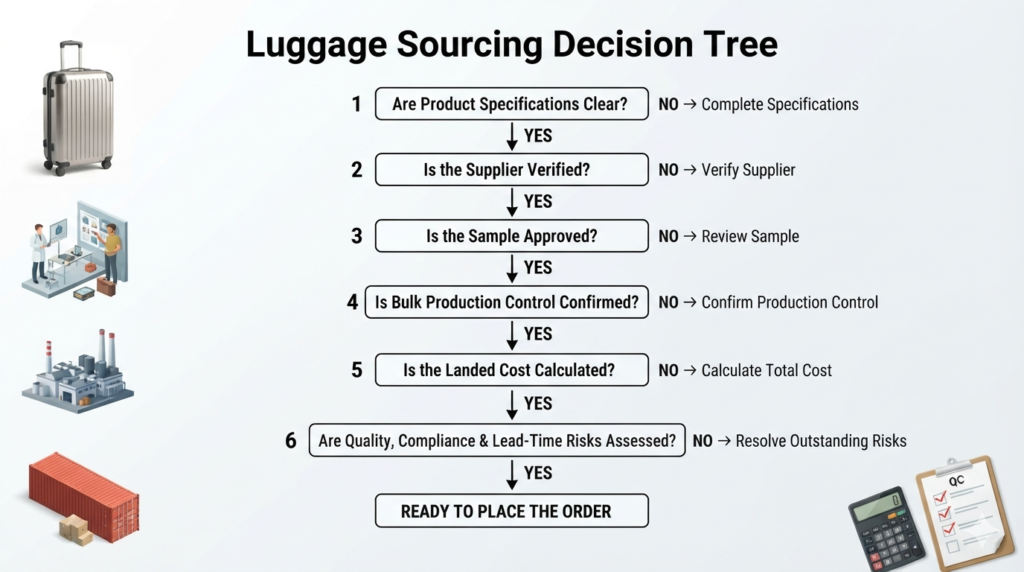
The Luggage Sourcing Decision Tree
A checklist tells you what to verify.
A decision tree helps you decide whether you are ready to place the order.
Step 1 — Are the product specifications clear?
NO
→ Stop and complete the product specification.
YES
↓
Step 2 — Has the supplier’s capability been verified?
NO
→ Request manufacturing evidence, relevant experience, equipment information and samples.
YES
↓
Step 3 — Has the sample been evaluated and approved?
NO
→ Review dimensions, materials, construction, functionality and appearance.
YES
↓
Step 4 — Is there a clear bulk-production control process?
NO
→ Confirm material control, production reference samples, QC checkpoints and component-change procedures.
YES
↓
Step 5 — Have you calculated the real landed cost?
NO
→ Add logistics, duties/taxes, inspection, packaging and other applicable costs.
YES
↓
Step 6 — Have quality, compliance and lead-time risks been assessed?
NO
→ Resolve the outstanding risks before placing the order.
YES
↓
READY TO PLACE THE ORDER
Developing a new luggage product?
Whether you are sourcing carry-on luggage, hard-shell suitcases, soft luggage or travel bags, the right manufacturing partner can help you evaluate materials, structure, customization, sampling, quality control and production requirements before you commit to a large order.
Looking for a reliable luggage manufacturing partner? Let’s discuss your product requirements and development plan.
Request a Luggage Development QuoteContact Us